Though it is late in the growing season, I had the urge to plant flowers this past week. It could have been because I ran across some of my favorite perennials that I couldn't find earlier in the season--coreopsis and coneflowers.
Besides the insects and birds that flowers attract, they are beautiful and fun to paint! Yesterday, I enjoyed an opportunity to sit near these garden additions and create coneflowers in my sketchbook using brush and paint without the detail of drawing. Coneflowers have a distinctive shape with daisy-like petals that loosely droop. How deeply the petals droop depends on the stage of the flower's maturity. This characteristic makes them good subjects for loose painting. By that, I mean watery painting with less concern about detail.

Besides planting purple coneflowers, I also planted a white coneflower variety. The white in flowers is particularly fun to paint. "White" in a watercolor painting is the lightest color/value in your painting. Since white flower petals generally reflect the colors around them, they offer a fun opportunity to play with wet-in-wet painting, letting the colors blend on the paper and a brush stroke of clean water carry pale pigment into petal shapes. I'll show you what I mean.
Below, you see how I created the watery flower images you see on the right hand side of the sketchbook at the top of this post. If you would like to give this way of creating coneflowers a try, use one of the images above, or a flower from your own garden or collection of images as a guide. If you already have experience with this type of painting, this exercise makes a fun and relaxing practice.
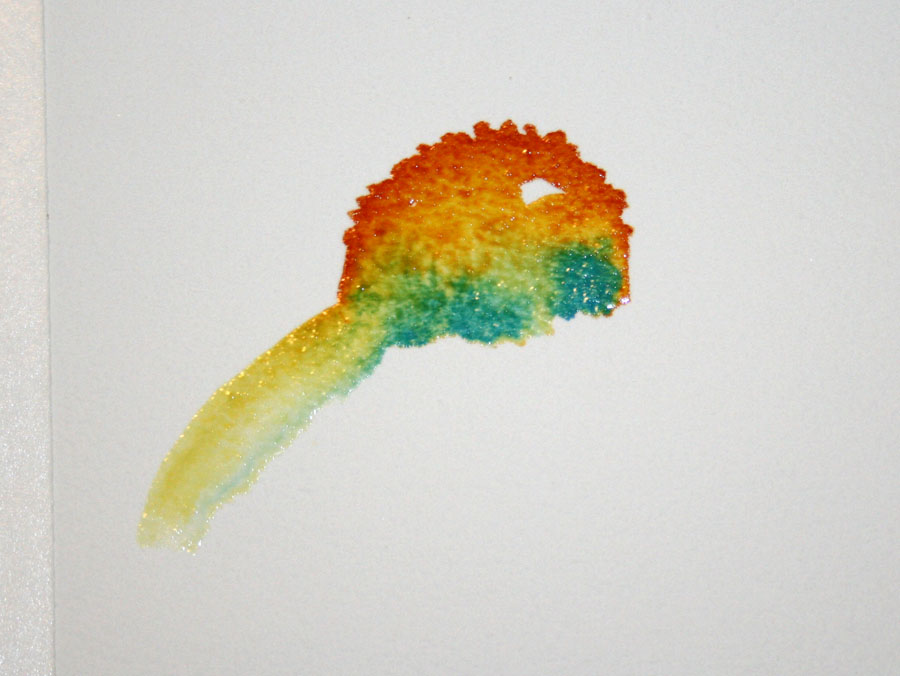
On dry paper, paint a coneflower head shape, as shown below. I used WN Quinacridone gold.
Have two containers of water handy, one to rinse your brush between colors, the other to load your brush with clean water. Brush clean water along the edge of the painted area and bring it down to form the shape of the flower head, as shown below. Leaving white areas is one way to add interest and give the impression of light reflection. Learning how much water your brush holds and how much you need to use comes with practice.
While this area is still wet, drop in some cerulean blue (or another blue of your choice) along the bottom edge.
Rinse your brush and load it with clean water. Touching the edge of the bottom of the cone shape, paint a petal shape with clear water coming down from the cone center. Pigment will flow into the water left by the brush stroke. Tilt your paper if needed to aid this movement.
Continue to create petal shapes with brush strokes of water. I enjoy the surprise of this technique and the richness of the color that is created when pigment is dropped into pigment. The cerulean blue and quinacridone gold blend to create a nice green like the underlying color seen at the base of the yellow and orange blossoms of the coneflower head.
In the next study, I dropped in WN French ultramarine blue and a touch of Daniel Smith Alizarin Crimson along the bottom edge.
Below, you see the variation that resulted.
Try a series of these studies and enjoy seeing a variety of interpretations of these lovely flowers. Try adding a stem and a leaf. And if you try this exercise and post your results on your blog, send me a link. If you would like, I can post the link here. If you don't have your own blog, and would like to share your results here, send an image to me at: viclcsw (at) aol (dot) com. Below, you see more of my studies.
I've used a scrap sheet of watercolor paper (with a rejected painting on the other side) and divided it with artist tape to create six separate painting areas for these studies.
Coneflowers are part of the aster (asteraceae) family, along with sunflowers and, like
sunflowers, have a flower head with many tiny blossoms. This is clearly one of my favorite flower families!