Monday, October 18, 2010

Sketching Birds in the Backyard

Sounds easy enough.  But there is definitely a shift between photographing birds and sketching them.  And another gigantic shift between sketching from a photo and trying to capture birds while they're moving around!  So what you see below is today's attempt.  My solution for everything that doesn't come easily....practice!
Whey all my busy hummingbird activity ended earlier in the month (last observed visit October 11th), I took all but one hummingbird feeder down, hung a suet basket with homemade suet, a sunflower seed feeder and put out a plate with a mix of each.  The bird-y word got around fast.

It is such a joy to watch these birds--cardinals, mockingbirds, chickadees, titmice, wrens, downies, nuthatches--at the bath and the feeder.  If you sit and observe for a while, you can tell which are the juveniles by their behavior, especially at the bird bath.  I had the joy of watching young chickadees trying to figure out how to drink without getting wet.

My bird bath sits crooked.  No matter how many times I straighten it and pile rocks around it, it always shifts. On this occasion a cardinal was perched drinking and two chickadee juveniles, one after the other, ended up in a spot where the water had shifted away from the edge.  It was a chuckle to see them stretch, nearly tip over, and flutter to upright themselves and keep from falling into the water.  They next landed on the opposite side to drink.  I mean, you bathe only when you want to, right?  
And I got this special mockingbird treat during another time I sat on the patio to observe.  What a hoot, to watch this mocker grab the back ball shaped tops that hold the feeder together.  At first I thought he/she was after an insect.  But then when he tried more than one angle, and moved on to try each one, I realized it was a juvenile trying to see if that big, fat, black, berry-looking thing was tasty!


My response to that stare, "I promise, I didn't do it!"


Tuesday, September 21, 2010

Painting a Loggerhead Sea Turtle

It's often that while painting a subject that my mind wanders through the moments of first encounter.  In the case of this unfinished Loggerhead watercolor, I also couldn't help but wonder about the details of what I was sketching, specifically, the scales on the turtles' head, how they were arranged, what they were made of, whether they varied or were uniformly arranged in a species.  
My search led me to a familiar realization that I don't know a whole lot about some things, turtles being among them, especially sea turtles.  It was humbling to land on the US Fish and Wildlife/North Florida Ecological Service "Sea Turtle Quick Facts" page (link provided below) and begin reading the description of Loggerheads.  I understood the first sentence.  But in the next, I encountered carapace and plastron and as I read on, costal scutes, nuchal scute, inframarginal scutes and bridges.  I needed a turtle dictionary!   

Sketching and painting heightens my senses and deepens my curiosity, making me eager to learn more.  I'll share my recent experience with Loggerhead sea turtles at Archie Carr National Wildlife Refuge in Brevard County, Florida, in an upcoming post.  But for now, get ready by brushing up on your memory of turtle anatomy and the language used to describe it.      


Sunday, September 5, 2010

Ruby-throated Hummingbirds and Sea Turtles

It has been such a joy to watch the hummingbirds that have come to my feeders this summer.  Those that live in northern breeding territories in Canada and the northern USA began their migration journey's in July, progressing southward approximately 18 miles per day.  In the southeastern USA where I live, in Tennessee, our birds have begun migration as well, the males departing earliest, leaving females with late fledglings and vigilant juveniles guarding nectar sources.  
All this activity has been an incredible thing to watch.  The more time I spend sitting near the feeders, the more I understand the necessity of all that chirping and diving and chasing that takes place.  In a few hours of observation, I may see a male define his territory with an incredible high-speed dive, a tentative fledgling at the feeder with his 'baby' gape still apparent, and two juveniles sparing in spiraling flight so ferociously that they both land on the ground.  The juxtaposition of so many aspects of their lives unfolding in front of me gives me deep pause.
And while I sketch these juveniles, internalizing every feather, the shape of their beaks, the position of their wings, their expression, I feel more and more connected to them, more and more hopeful that they will each survive their migration journey.  My art inspires my love for what I'm painting, just as surely as the nature I encounter inspires my art.
I experimented with salt in this painting, sprinkling a little too much, in my opinion, in a couple of places to suggest the sparkling of light in the trees.  While I waited for the paint to dry, I sketched a loggerhead sea turtle.  This was my first sketch of a turtle of any kind.  And as my pencil gave it shape, I fell in love with it all over again, bringing it even deeper into my heart, if that's possible.
Standing on a dark beach in the light of a full moon with the sound of the surf breaking while watching a sea turtle lay her eggs was quite enough to fortify my love for these giant marvels forever.  And while I'm sketching, I internalize what I know about them even more, see more deeply, and feel more deeply.  Painting is a meditation of sorts, and during that meditation I am one with this turtle, enjoying her beauty, the shape of her head, the sheer size of her body, those deep ancient eyes.  Every aspect of what I see and feel about her moves through me and forms the image I create on paper.
And when I paint hummingbirds, I'm one with their high-speed world, filled with a fledgling's uncertainty and mindful of the power and speed of that mature male.  I marvel at what they show me and how nature has put it all together.  Art and nature, nature and art.  They make my world a richer place.


Sunday, August 15, 2010

Hummingbird and Downy Woodpecker on Nectar Feeder

If you love nature and you love to recreate what you see and experience in watercolor, there couldn't be anything more fun than diving back into a subject and watching it come to life in a painting.  When it comes to birds, that could also mean tripling and quadrupling your fun!
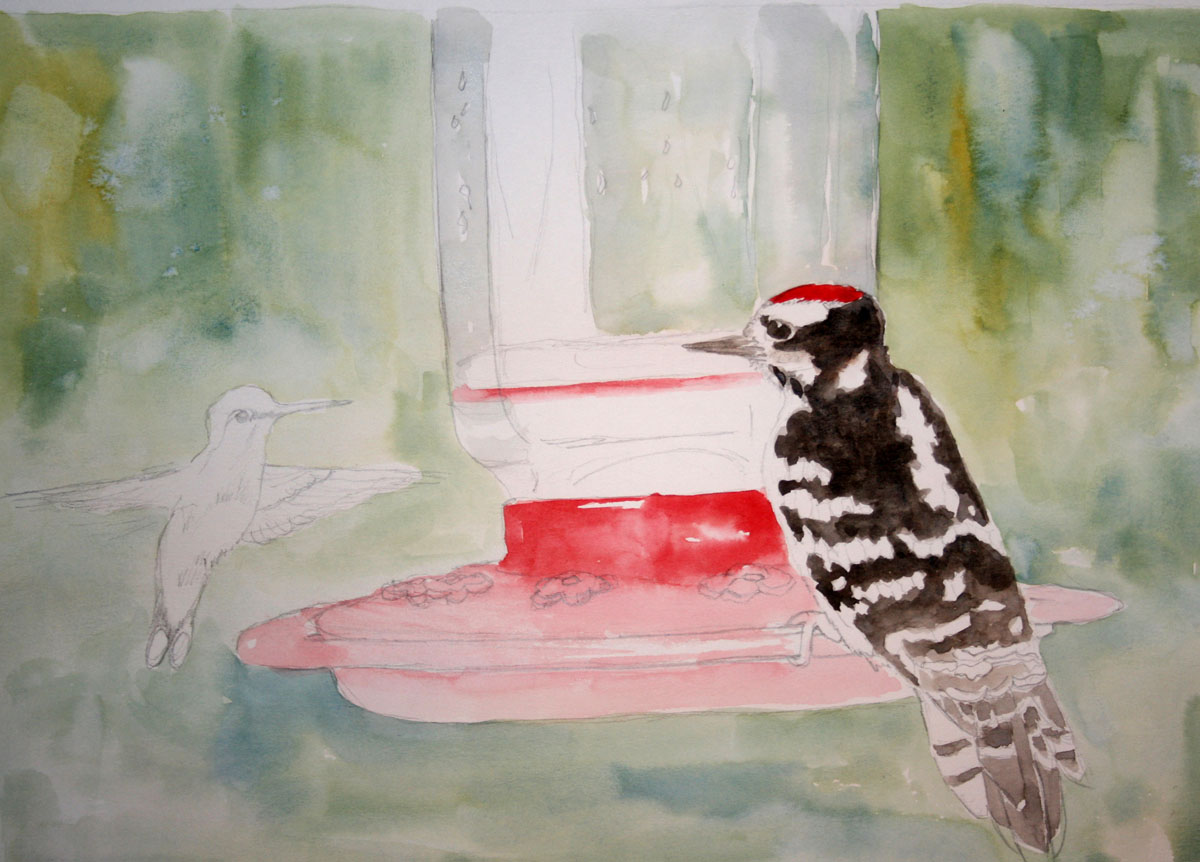
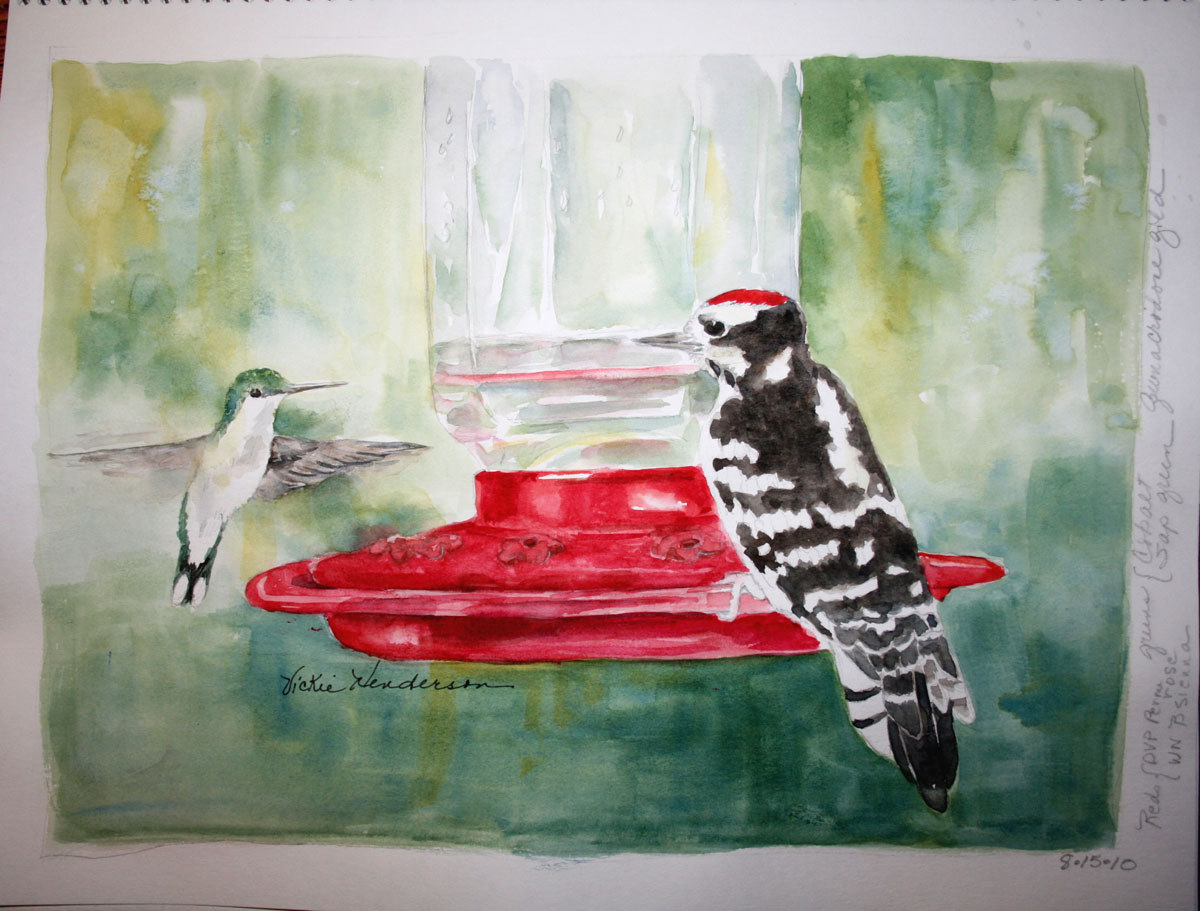
It has been fun on top of fun to hear and witness this male Downy woodpecker visiting my nectar feeders intended for tiny hummingbirds.  But top it off with interactions between the two species and smiles just keep coming.

Painting this sketch had the same effect.  I smiled a lot.  And when you're smiling there is no worry about outcome.  You're just loving your subject and loving the opportunity to give it center stage.  And there's a number of ways to create that stage, among them, painting light against dark, soft against hard, and color that leads the eye through the painting.  I often approach these elements intuitively
I chose my background colors in this sketch first, focusing on the greens of the trees and the light in the spaces in the unfocused background.  A principle I learned from my long-time watercolor mentor and instructor, Ann K Lindsay--the fewer colors you use, the more unified your painting.   I've found this to be excellent advise that stuck with me and greatly simplifies decisions!
In this sketch my primary colors are DVP Cobalt Blue , WN Quinacridone Gold for my yellow, and DVP Permanent Rose for my red.  (Note: brands with the same color name vary in actual color.  WN stands for Winsor & Newton brand paint, DVP for Da Vinci).  The rest of my colors consisted of two neutrals and sap green, all used to alter the shades of the above three primaries:  DVP Sap Green, to add a little warmth to green made with the gold and blue; WN Van Dyke Brown, used with cobalt to make black; WN Burnt Sienna used with rose to warm it.  I also use burnt sienna with blue to make grays, adding a touch of the other colors on the palette as needed.  
As I'm working on the light washes, I'm making a map of sorts.  I'm aware that my hummer and the water in the feeder will both be the same colors as the background.  This means I have to draw the viewers eye to my subject with the placement of values, that is, the positioning of darks and lights.  At this point (above), I also add color to the nectar container which reflects the background, and to the water in the feeder as a reference for these values.  The water and the feeder represent my lightest lights.

The hummer is next, creating wings that have a fairy-like movement of 40 to 80 beats per second.


To soften edges on the hummer's wing, I laid down paint strokes, rinsed my brush, blotting excess water from the brush with a sponge or paper towel, then brushed along the edge of the paint.  The paint edge is softened by the  moisture from the brush.  The amount of water you leave in the brush controls how far the pigment will spread from the original line.  

One way to suggest hummer wing movement is illustrated below--a combination of disconnected shapes, blurs, a mix of hard and softened lines.
Below is the almost finished sketch, created in one of my favorite sketchbooks made by Aquabee, on 11 x 14 paper.  What made me realize it wasn't quite finished was a glimpse at an LCD image on my camera that highlighted the widely separated gold areas.    
The yellow in this sketch is like an accessory with a special function.  It either helps move the eye through the painting or it distracts, especially since there is no yellow in my two stars.  So, I added yellow to areas where 'my eye wanted to see yellow', moving left to right from one side of the painting to the other, dabs of yellow glaze leading through the two birds.

You may already know how this dictate-from-the-eyes feels.  It's a sensation that is visually uncomfortable, that is, it bothers until the correction is made.  And when it's right, you know it--your eyes are happy again.  See what you think by comparing the finished sketch below to the one above.
In bird-watching, the intuitive ability to identify a bird by its shape and movement is referred to as 'jizz'.  It's a wholistic and instant recognition.  It's learned.  Painting works the same way.  Besides helping you learn the skills of manipulating water and pigment on paper, practice develops jizz, your eye's intuitive ability to know what your painting needs in order to please you.  


Friday, August 6, 2010

The Curious Wood Stork

Below you see a Wood Stork I sketched nine years ago.  In fact, this was both the first time I attempted to record my travel experience in a sketchbook and my first sightings of Wood Storks.  I had to get out my field guide to be certain of the species.  I also didn't have my digital camera back then for reference images, so the sketch was created from my field guide and my memory, giving it a whimsical quality.  
Sketchbooks are tons of fun, both creating them and looking back on them.  They reflect the mood of the moment as much as the subject.  Below is another Wood Stork sketch created this year.  In this encounter, I had the fun surprise of seeing this bird standing close-up, near the road.  When you are observing from a car, birds and animals are often undisturbed and may stay around allowing amazing looks.
My impression of this endangered bird--a bird draped in chiffon-like plumage topped off with a head full of wrinkles and scales.  What a combination.  When I looked at my photo images later, all I could think about was the fun I would have sketching him!  And while I was sketching all those scales and wrinkles on his head, I wondered more and more what this characteristic was all about.
To create this sketch, I experimented with masking fluid to save the feathery edges of the plumage and used a disposable skewer to make the lines.  This avoids soaping a brush to prevent the bristles from sticking together and also solves some of the challenge of making fine lines.  But even with a sharp tipped skewer, the fineness of the line takes some practice.  After dipping the stick in the fluid, droplets form on the tip.  What worked for me was to place the drop of fluid in a large area and drag a finer line of liquid to the edge of the feather.
Since rubbery masking fluids deteriorate with exposure to air and lose their effectiveness over time, I've poured some into an old film canister, to lessen exposure to the original bottle, and labeled it with the type of mask and date.  Have you ever picked up a bottle of mask and wondered how old it is?  At least on this bottle, there was no date anywhere.  Masks are said to have an effective life of approximately one year after they're opened.

This sketch also reinforced the practice of walking away from the table for a while, sometimes overnight, to discover what fresh eyes will see.  In this case I noticed that the placement of the eye didn't look right.  A closer look and I realized the problem was the height of the crown. 

A light scrub and a new crown line and the problem was solved.


Wednesday, July 21, 2010

Sketching a Limpkin in Water

More time please!  A thousand images to paint and so little time.  I could go out in nature every day for the rest of my life and never get enough of it.  And then there's the time needed for painting.  I have enough inspiration right now to keep me busy for months.  
I began this sketch by applying liquid resist to save the reeds and edges of the bird while I added a wash of blue.      
The wash ended up lighter than I wanted, reminding me to make a bigger, juicier puddle of paint next time.  On the other hand, smooth water reflects light and light areas are part of what we see when we look out on water.  When the paint dried, I removed the resist.
Below, I added color to the face and bill. 
When I stepped back from the sketch, I didn't like the brown I had mixed, too dark.  So I dried the paint thoroughly and using a scrub brush, lightened the brown areas.  I then changed the paint mix to a lighter shade of brown, a slightly different mixture of Cobalt blue and Burnt Sienna, with a touch of Van Dyke Brown.
At this point, I shifted focus and spent sometime creating the shading around the larger body feathers.  I applied paint first, then softening the edges.  It's one of those details I enjoy.  It was while working on this less stressful area (meaning I've practiced it more), that I noticed the shadow.  I had completely lost the slender shadow of the head and neck.  Checking to be sure the paint was completely dry before starting, I scrubbed out the right side of the shadow (above).  
Above you see my two most used scrubbers.  The one on the left is about 3/8 in wide and soft, for light scrubbing in larger areas.  The one on the right is made of stiff bristles and works well for tight areas.  The word scrub is a misnomer, really, because the idea is not to scrub the paper, but to lift off the paint.  You want to preserve the paper's surface as much as possible while removing pigment.  The operative word is "lift".  Apply clean water with the scrubber, brush a few strokes with a lifting motion, then blot with tissue or paper towel.  The brush stroke loosens the paint; the blotting lifts it off the paper.    
I added detail to the reeds, corrected the body shadow shape (see top image), and added detail to the rest of the feathers.  To finish, I brightened white areas on the plumage by adding some white gouache.

9 x 12 watercolor on Arches 140# paper.


Saturday, July 10, 2010

A Florida Scrub Jay and the Illusive Nature of Confidence

Sometimes I wonder where my confidence goes.  It's as though it has a mind of its own.  One minute its around to help me move forward, in the next it has vanished and can't be found. Instead I hear a doubting voice.
Natalie Goldberg, author and writing teacher, calls this thinking "monkey mind", a mindless chatter with endless ways of thwarting our efforts.  For me, it is likely to show up when I'm trying something new, when I'm tired, feeling pressured, or when I set out to do something that I haven't practiced for a while.
Fear is the culprit, of course.  And the dialog goes something like, "whatever possessed you to think you could do this?"   It's a critical voice, a fearful voice, and it ultimately warns, don't take this risk, stay in safe territory.  It's also the anxiety that builds while you're still in the void, while you're facing the blank paper.   The inspiration to create requires that you step outside your comfort zone, that you put yourself out there and move forward despite uncertainty.
Confidence requires action.  When I begin a painting, I have some idea of what I want to see happen, but it is not until I start the journey that I can see the path more clearly.  Each decision forms the basis for the next, until the painting begins to reveal itself.  Sometime during the process, anxiety fades, time disappears and I notice that I'm smiling.  
It's one of the delights of watercolor, a medium that is fresh, alive, full of movement and surprises.  I have some control, some idea of what to do, but I won't know the whole of it until the painting is finished.  A bit like life, isn't it?  And despite the anxiety generated, mystery is key to the dance.  When the music starts, when the watercolor moves, you soon forget those nagging doubts and just dance.
As I worked on this painting, I had some concern that my values were going to be too similar throughout and that I might not be able to remedy this.  So I turned my focus to my subject, painting in the detail so I could see the relative lights and darks more clearly.  Two things happened.  Foremost, I fell in love with the bird again and that gave my confidence a boost.  Secondly, once the color values in the bird were established, the foliage values began to fall into place.      

9 x 12" Watercolor on 140# Arches cold press paper


Ocean Trail at Rancho Palos Verdes Preserve, California--2015

Ocean Trail at Rancho Palos Verdes Preserve, California--2015

Joshua Tree National Forest, California, with son Chad and daughter Thuan--2015

Joshua Tree National Forest, California, with son Chad and daughter Thuan--2015
Photo credit: Thuan Tram

Bird banding with Mark Armstrong at Seven Islands State Birding Park - 2014

Bird banding with Mark Armstrong at Seven Islands State Birding Park - 2014
Photo courtesy of Jody Stone

Birds Close-up

Birds Close-up
Photo courtesy of Karen Wilkenson

Enjoying Gray Jays in Churchill, Manitoba

Enjoying Gray Jays in Churchill, Manitoba
Photo courtesy of Blue Sky Expeditions

A dog sled experience with Blue Sky Expeditions, Churchill, MB--2014

A dog sled experience with Blue Sky Expeditions, Churchill, MB--2014
Photo courtesy of Blue Sky Expeditions

Churchill, Manitoba--2014

Churchill, Manitoba--2014
Photo courtesy of Blue Sky

2014 Hummingbird Festival

2014 Hummingbird Festival
Photo courtesy of Jody Stone

Smithsonian National Zoo with one of my Whooping Crane art banners and son, John--2014

Smithsonian National Zoo with one of my Whooping Crane art banners and son, John--2014

Muir Woods on the Dipsea Trail at Stinson Beach, California--2014

Muir Woods on the Dipsea Trail at Stinson Beach, California--2014
Photo courtesy of Wendy Pitts Reeves

Checking out the gulls at Stinson Beach--2014

Checking out the gulls at Stinson Beach--2014
Photo courtesy of Wendy Pitts Reeves

Discovery Hike in Denali National Park and Preserve, Alaska--2012

Discovery Hike in Denali National Park and Preserve, Alaska--2012
Photo courtesy of Ruth Carter
Related Posts with Thumbnails