Showing posts with label hummingbirds. Show all posts

Friday, August 28, 2015

Hummingbird Inspiration!

Hummingbird migration is one of my favorite seasonal events.  In mid-July our first hummingbird nestlings fledged, more than doubling the number of hummingbirds at our yard feeders.  In a short time they were joined by migrants, increasing activity in the garden substantially. If you sit still for a while you can pick out the youngsters by watching their behavior.
Young juveniles look just like adult females with the exception of feathers that are more gray than green, a characteristic that is hard to see at a distance.  Behavior is the primary give-away to recognizing a recently fledged juvenile.
While females are all business--coming to the feeder for a drink and leaving quickly to return to nesting activities--juveniles hang-out.  They sit on limbs, hide in the foliage, watch the activities for a while and tentatively approach the feeder.  They also explore everything, especially the flowers. 
Juvenile hummingbird observations inspired my two "mini-bell" sketches above.  Both were created using negative painting to form the leaf shapes that make up the tangle of foliage so characteristic of minature petunias.  "Hummingbird and Million Bells", above, began as a wet-on-wet multi-colored wash of Quinacradone Gold, Quinacradone Rose and Cobalt Teal Blue (all Daniel Smith watercolors). 
These three primary colors--red, yellow, blue--provide the basic palette for the sketch. Variations of green were made by mixing the gold and teal together.  Only two additional pigments were added, Burnt Sienna and Lunar Black.  Lunar Black was added sparingly in the final touches for texture and as the darkest dark shapes.
With each layer of paint, the goal is to add some new leaf and stem shapes appearing behind the lighter shapes. Because these shapes are darker and the space around them, darker still, they recede into the background and give the painting depth.
Negative painting can feel intimidating at first because it's easy to get lost and forget where your layer begins and should end.  Taking your time, imagining leaf and stem shapes as you work, and working in small areas at a time will help transform a confusing effort into a relaxing experience.
The nice thing about leaf shapes is there is natural variation in their size and shapes and you don't have to worry about getting them down perfectly. Mistakes happen and disappear!
If you are new to negative painting, visit my blog post, "Fun with Fall Leaves",  for a fun exercise to get you started.

More posts about hummingbirds:  hummingbird studies and hummingbirds in flight

Visit my companion blog and enjoy the Wonder of Hummingbirds Festival

Friday, May 9, 2014

A Great New Publication about Hummingbird Gardening

Just in time for the return of our Ruby-throated Hummingbirds, a new publication is available free as a pdf download!   I am excited to have my hummingbird image of a juvenile Ruby-throat nectaring a Cardinal Flower featured on the cover and three more images on the inside pages!

Hummingbird Gardening in Tennessee is published by the University of Tennessee Institute of Agriculture.  The book is co-authored by Marcia Davis, Master Gardener, member of the Knoxville bird club (Knoxville Chapter of the Tennessee Ornithological Society) and the Bird Life columnist for the Knoxville News Sentinel, and Emily Gonzalez of the UT Extension.

The fifteen page booklet is full of useful information about creating hummingbird habitat in your garden and lists the kinds of flowers and native plants that are particularly attractive to hummingbirds.

The free pdf can be downloaded from this link:  Hummingbird Gardening in Tennessee.

Links and resources:
Hummingbird art
Hummingbird Notes
More about Ruby-throated Hummingbirds
Tennessee's wintering hummingbirds

Thursday, August 29, 2013

New Hummingbird Note Cards!

This is one of my favorite times of year!  It's the time when local Ruby-throated hummingbird juveniles are out of the nest and moving around, and northern males are migrating through, fattening up on insects as they get ready for their long migration journey across the Gulf of Mexico.
The males leave first and are usually gone from east Tennessee by the middle of September.  Amazingly, that is only a couple of weeks away.  They will be followed by the females who have finished nesting, and the juveniles will leave last, along with the late nesting females.
In the spring I refurbished my hummingbird garden and added more hummer-attracting plants--cardinal flowers, black and blue salvia, autumn salvia and pineapple sage.  Pentas, lantana, and butterfly weed are more for butterflies, but they attract hummingbirds too.  I then topped the garden off with nine hummingbird feeders.
Every time I have the opportunity and there's good light, I plant myself near the flowers and enjoy the challenge of capturing a hummingbird in flight, nectaring a flower or sometimes while they're perched on the feeder--fun, funny and beautiful!  

All of this hummingbird watching stirs a deep love and enjoyment of hummingbirds and inspires art.  
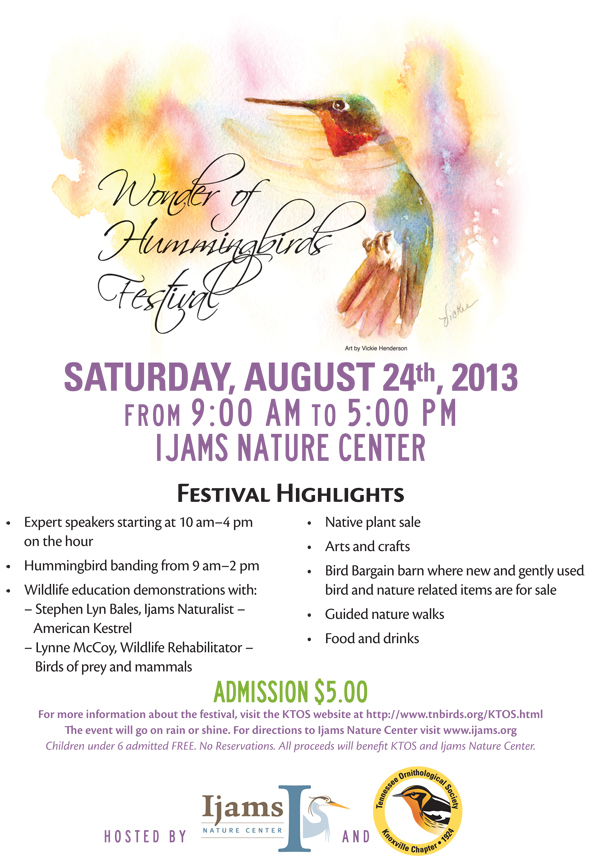
We have just spent a day of celebrating hummingbirds at our Wonder of Hummingbirds Festival sponsored by the Knoxville Chapter of the Tennessee Ornithological Society and Ijams Nature Center in Knoxville. Visit by blog post on the festival and check out the T-shirts the volunteers are wearing!  My male hummingbird study, created about this time last year, became the logo art for the festival and was printed on the festival T-shirts and the banner!  (above)

To visit more hummingbird art on this blog visit:  hummingbirds.

Friday, August 23, 2013

Wonder of Hummingbird Festival August 24th--TOMORROW!

Join us at the Wonder of Hummingbird Festival tomorrow, August 24th and Ijams Nature Center, Knoxville Tennessee.

A fun, exciting event that will be filled with hummingbirds!  Hummingbird banding with Mark Armstrong our very gentle Master Bander of songbirds and hummingbirds, expert speakers on several different nature subjects including bluebirds, hummingbirds, bears and wolves, vendors with plants and nature crafts, lots of food vendors and wildlife demonstrations!  Great fun and education for the whole family!  

Visit this link to get more information and complete directions:  Wonder of Hummingbird Festival
To visit more hummingbird art on this blog visit:  hummingbirds
More information about hummingbird banding and hummingbirds.

Friday, August 9, 2013

The Hummingbird Days of Summer

Breeding season is coming to a close for hummingbirds in our area, except for a few late nesters.  Lots of juveniles are visiting the feeders and hummingbirds from northern areas are starting to migrate.  This is when activity at nectar feeders and in gardens becomes very busy and its also my favorite time to paint hummingbirds!
The above hummingbird visiting a black and blue salvia is one of my sketches this season.
Below, a male hummingbird visits the black and blue blossoms.  (Some varieties are the deep blue below, others look deep purple.)

Besides enjoying myself, I'm getting ready for the Wonder of Hummingbird Festival in Knoxville, TN, August 24th at Ijams Nature Center.  We will be celebrating hummingbirds and their migration with Mark Armstrong, Master Bander, who will demonstrate how he bands hummingbirds so scientists can discover more about the health and behavior of the population.


Thursday, September 8, 2011

Hummingbird Studies--Movement and Light

I will just about come up with any excuse to sit outside with hummingbirds this time of year.  Since tropical storm Lee has pushed rain and colder air our way in Tennessee, there has been an increased mob of hummingbirds gathered around my five feeders. They are especially active in the early morning and late evenings, just before departing to continue their migration as night migrants.  
Yesterday evening, while refilling a couple of feeders, I marveled as all feeders were occupied with 3-4 hummers at a time.  No sooner did they finish their drink, than they were back to fanning tails, chirping and giving chase.  Hummingbirds in flight are not easy to see for more than a few seconds, let alone, sketch, so I rely on my camera to give me details about posture and plumage.  

Even using my camera (Canon Rebel xi with 300 mm zoom lens) is a delightful challenge.  It requires patience, anticipation and steady nerves.  But what it also gives me is a closer view.  My current binoculars will not focus within the shorter distances needed for sketching, so my camera serves as a substitute, and occasionally gives me a nice in-flight reference image.  
Right now I am delighting in watching hummingbird behavior.  Mature birds and juveniles behave very differently.  When trying to capture these birds in a sketch, it is also a challenge to try to capture the light and movement which is so much a part of the personality of hummers.  So after hours of watching them, I enjoy trying to capture what I've internalized in a sketch.  This is resulting in a series of hummingbird studies. I could also label them studies of movement and light.

I am sure that each study will continue to look very different, as these two do.  These are playful experiments.  My challenge is to not 'mess' with what's happening on the page, but let the water and pigment move freely.  While painting, I'm focusing on the experience of hummingbirds, rather than the detail of the bird.  That's my goal, at least. Those beautiful details are hard to resist!
Bloom or watermark created by dropping clear water into pigment on paper.

A different watermark created by dropping clear water into an area that has been salted.


Sunday, September 5, 2010

Ruby-throated Hummingbirds and Sea Turtles

It has been such a joy to watch the hummingbirds that have come to my feeders this summer.  Those that live in northern breeding territories in Canada and the northern USA began their migration journey's in July, progressing southward approximately 18 miles per day.  In the southeastern USA where I live, in Tennessee, our birds have begun migration as well, the males departing earliest, leaving females with late fledglings and vigilant juveniles guarding nectar sources.  
All this activity has been an incredible thing to watch.  The more time I spend sitting near the feeders, the more I understand the necessity of all that chirping and diving and chasing that takes place.  In a few hours of observation, I may see a male define his territory with an incredible high-speed dive, a tentative fledgling at the feeder with his 'baby' gape still apparent, and two juveniles sparing in spiraling flight so ferociously that they both land on the ground.  The juxtaposition of so many aspects of their lives unfolding in front of me gives me deep pause.
And while I sketch these juveniles, internalizing every feather, the shape of their beaks, the position of their wings, their expression, I feel more and more connected to them, more and more hopeful that they will each survive their migration journey.  My art inspires my love for what I'm painting, just as surely as the nature I encounter inspires my art.
I experimented with salt in this painting, sprinkling a little too much, in my opinion, in a couple of places to suggest the sparkling of light in the trees.  While I waited for the paint to dry, I sketched a loggerhead sea turtle.  This was my first sketch of a turtle of any kind.  And as my pencil gave it shape, I fell in love with it all over again, bringing it even deeper into my heart, if that's possible.
Standing on a dark beach in the light of a full moon with the sound of the surf breaking while watching a sea turtle lay her eggs was quite enough to fortify my love for these giant marvels forever.  And while I'm sketching, I internalize what I know about them even more, see more deeply, and feel more deeply.  Painting is a meditation of sorts, and during that meditation I am one with this turtle, enjoying her beauty, the shape of her head, the sheer size of her body, those deep ancient eyes.  Every aspect of what I see and feel about her moves through me and forms the image I create on paper.
And when I paint hummingbirds, I'm one with their high-speed world, filled with a fledgling's uncertainty and mindful of the power and speed of that mature male.  I marvel at what they show me and how nature has put it all together.  Art and nature, nature and art.  They make my world a richer place.


Sunday, August 15, 2010

Hummingbird and Downy Woodpecker on Nectar Feeder

If you love nature and you love to recreate what you see and experience in watercolor, there couldn't be anything more fun than diving back into a subject and watching it come to life in a painting.  When it comes to birds, that could also mean tripling and quadrupling your fun!
It has been fun on top of fun to hear and witness this male Downy woodpecker visiting my nectar feeders intended for tiny hummingbirds.  But top it off with interactions between the two species and smiles just keep coming.

Painting this sketch had the same effect.  I smiled a lot.  And when you're smiling there is no worry about outcome.  You're just loving your subject and loving the opportunity to give it center stage.  And there's a number of ways to create that stage, among them, painting light against dark, soft against hard, and color that leads the eye through the painting.  I often approach these elements intuitively
I chose my background colors in this sketch first, focusing on the greens of the trees and the light in the spaces in the unfocused background.  A principle I learned from my long-time watercolor mentor and instructor, Ann K Lindsay--the fewer colors you use, the more unified your painting.   I've found this to be excellent advise that stuck with me and greatly simplifies decisions!
In this sketch my primary colors are DVP Cobalt Blue , WN Quinacridone Gold for my yellow, and DVP Permanent Rose for my red.  (Note: brands with the same color name vary in actual color.  WN stands for Winsor & Newton brand paint, DVP for Da Vinci).  The rest of my colors consisted of two neutrals and sap green, all used to alter the shades of the above three primaries:  DVP Sap Green, to add a little warmth to green made with the gold and blue; WN Van Dyke Brown, used with cobalt to make black; WN Burnt Sienna used with rose to warm it.  I also use burnt sienna with blue to make grays, adding a touch of the other colors on the palette as needed.  
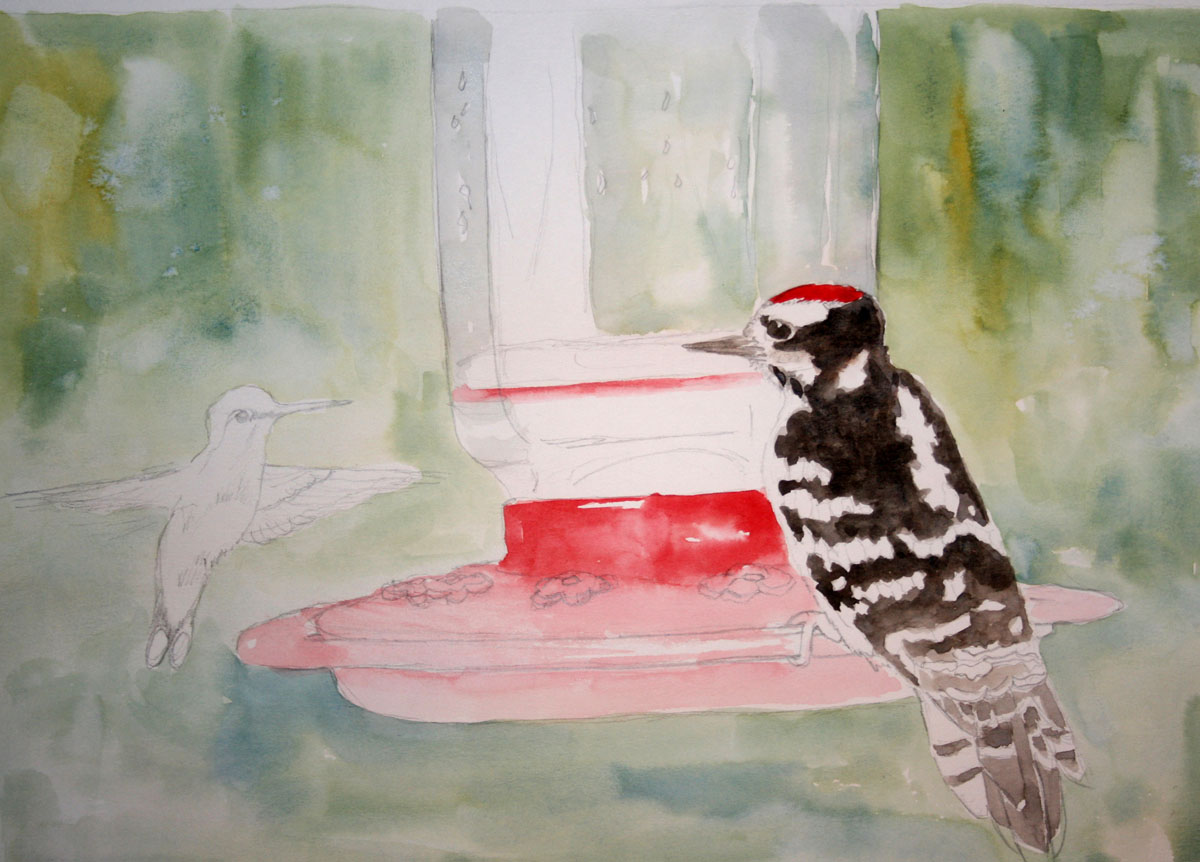
As I'm working on the light washes, I'm making a map of sorts.  I'm aware that my hummer and the water in the feeder will both be the same colors as the background.  This means I have to draw the viewers eye to my subject with the placement of values, that is, the positioning of darks and lights.  At this point (above), I also add color to the nectar container which reflects the background, and to the water in the feeder as a reference for these values.  The water and the feeder represent my lightest lights.

The hummer is next, creating wings that have a fairy-like movement of 40 to 80 beats per second.


To soften edges on the hummer's wing, I laid down paint strokes, rinsed my brush, blotting excess water from the brush with a sponge or paper towel, then brushed along the edge of the paint.  The paint edge is softened by the  moisture from the brush.  The amount of water you leave in the brush controls how far the pigment will spread from the original line.  

One way to suggest hummer wing movement is illustrated below--a combination of disconnected shapes, blurs, a mix of hard and softened lines.
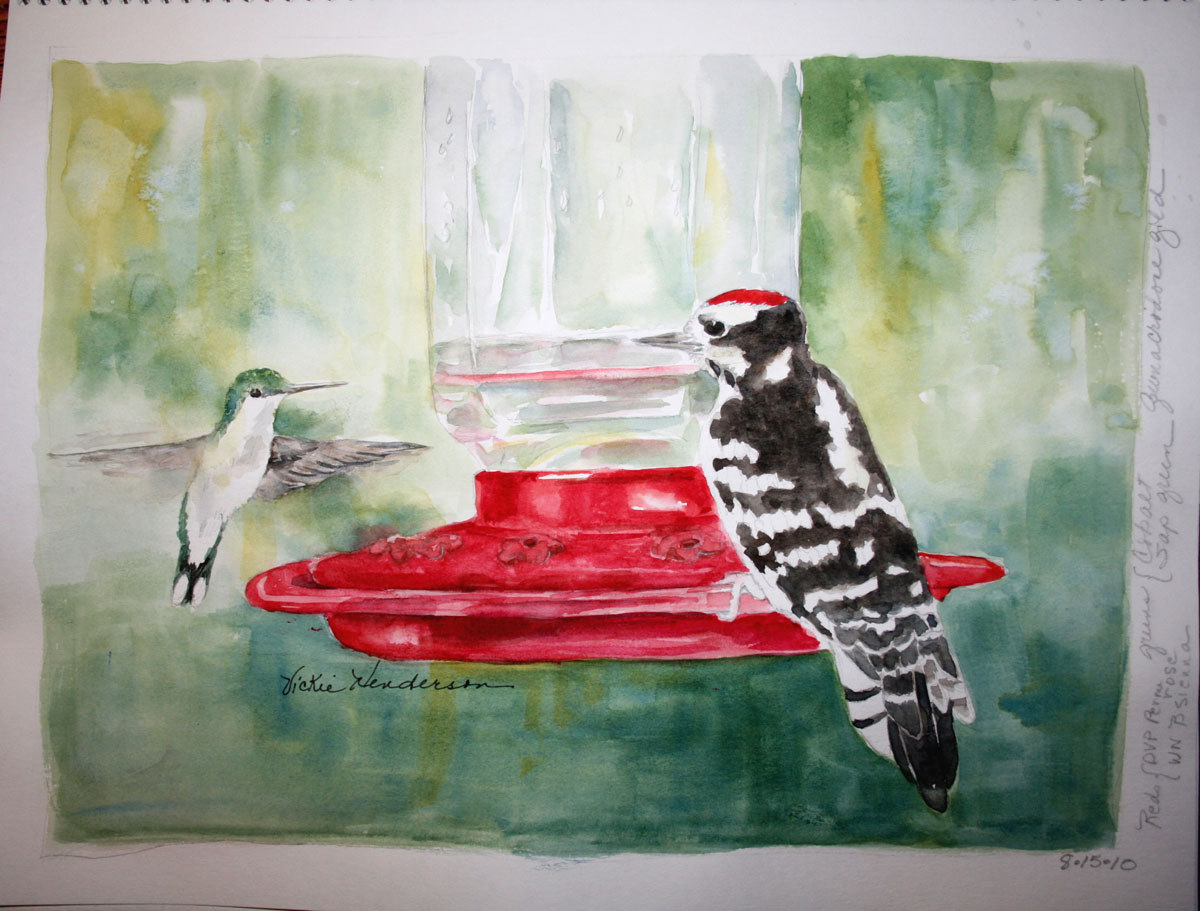
Below is the almost finished sketch, created in one of my favorite sketchbooks made by Aquabee, on 11 x 14 paper.  What made me realize it wasn't quite finished was a glimpse at an LCD image on my camera that highlighted the widely separated gold areas.    
The yellow in this sketch is like an accessory with a special function.  It either helps move the eye through the painting or it distracts, especially since there is no yellow in my two stars.  So, I added yellow to areas where 'my eye wanted to see yellow', moving left to right from one side of the painting to the other, dabs of yellow glaze leading through the two birds.

You may already know how this dictate-from-the-eyes feels.  It's a sensation that is visually uncomfortable, that is, it bothers until the correction is made.  And when it's right, you know it--your eyes are happy again.  See what you think by comparing the finished sketch below to the one above.
In bird-watching, the intuitive ability to identify a bird by its shape and movement is referred to as 'jizz'.  It's a wholistic and instant recognition.  It's learned.  Painting works the same way.  Besides helping you learn the skills of manipulating water and pigment on paper, practice develops jizz, your eye's intuitive ability to know what your painting needs in order to please you.  


Ocean Trail at Rancho Palos Verdes Preserve, California--2015

Ocean Trail at Rancho Palos Verdes Preserve, California--2015

Joshua Tree National Forest, California, with son Chad and daughter Thuan--2015

Joshua Tree National Forest, California, with son Chad and daughter Thuan--2015
Photo credit: Thuan Tram

Bird banding with Mark Armstrong at Seven Islands State Birding Park - 2014

Bird banding with Mark Armstrong at Seven Islands State Birding Park - 2014
Photo courtesy of Jody Stone

Birds Close-up

Birds Close-up
Photo courtesy of Karen Wilkenson

Enjoying Gray Jays in Churchill, Manitoba

Enjoying Gray Jays in Churchill, Manitoba
Photo courtesy of Blue Sky Expeditions

A dog sled experience with Blue Sky Expeditions, Churchill, MB--2014

A dog sled experience with Blue Sky Expeditions, Churchill, MB--2014
Photo courtesy of Blue Sky Expeditions

Churchill, Manitoba--2014

Churchill, Manitoba--2014
Photo courtesy of Blue Sky

2014 Hummingbird Festival

2014 Hummingbird Festival
Photo courtesy of Jody Stone

Smithsonian National Zoo with one of my Whooping Crane art banners and son, John--2014

Smithsonian National Zoo with one of my Whooping Crane art banners and son, John--2014

Muir Woods on the Dipsea Trail at Stinson Beach, California--2014

Muir Woods on the Dipsea Trail at Stinson Beach, California--2014
Photo courtesy of Wendy Pitts Reeves

Checking out the gulls at Stinson Beach--2014

Checking out the gulls at Stinson Beach--2014
Photo courtesy of Wendy Pitts Reeves

Discovery Hike in Denali National Park and Preserve, Alaska--2012

Discovery Hike in Denali National Park and Preserve, Alaska--2012
Photo courtesy of Ruth Carter
Related Posts with Thumbnails