11 x 14 watercolor, Monarch on White Crownbeard.
Watercolor is rich in it's versatility, in the many different ways you can approach a subject while attempting to capture the interplay of color and light. I suppose that is true with any medium, but watercolor moves as you paint and that quality gives it a richness and a freshness that is always full of surprises. I think it is this interaction, between the pigment and water, that always stirs in me the desire to explore it more. Each time I paint and see the results, I want to try again, see what other ways I can find to express what I'm seeing and feeling.
I painted this monarch primarily from a sketch in my sketchbook. While painting, I relied chiefly on the sketch rather than reference photos or having the subject in front of me. It is a different experience, a freeing experience. Sketches always feel lighter to me, free from the tension that painting a "real" painting sometimes causes. It is wonderful practice and a wonderful way to keep your painting fresh. There is a looseness in sketching that comes from the fact that you know it's practice, there's no pressure. You're uptight left brain goes to sleep, after all, you can easily start over again. And there is a practical limit to the amount of detail you can capture or even want in a sketch. In fact, the lack of detail is the magic of a sketch.
Having said that, I love detail. It is part of my fascination with nature and is one of the reasons I enjoy studying my subjects with my camera. The camera brings the subject closer, allowing me to slow down the activity so I can learn more about what's happening. And what I discover never fails to delight me. But a painting is more than just a rendition of the subject in its environment. A painting is also an interaction.
This interaction is one of the most intriguing and challenging aspects of watercolor. There are the primary interactions that we are all familiar with, between pigment and water, paint and brush, and of course, between the visual reality and what the artist sees and feels. But there is also the important interaction the viewer has while viewing the art. When the viewer sees the final work, we, as artists, hope they will be inspired.
For me, the delight and inspiration of watercolor is stirred by that mysterious quality in its movement. Using a photograph for reference, as I often do, can sometimes suck me into detail, which can result in a tight rendition rather than an image that is fluid. This is what I noticed as I worked on this painting. The sketch freed me to just paint, to focus on what I found to be beautiful about the subject, to stay with the light and airy quality of both the butterfly and the flowers, leaving the details more to the imagination.
It is this stimulation of imagination that is the root of inspiration. As creative beings, we love feeling this. And when my painting is finished, it is this inspiration that I want others to feel right along with me.
Showing posts with label sketchbook. Show all posts
Friday, June 17, 2011
Monday, April 4, 2011
Clingman's Dome at Sunset
I'm not sure whether I'll remember the beautiful sunset more vividly or the bone-chilling wind. We reached Clingman's Dome just in time to take in this gorgeous, multi-colored sky as the sun slipped down below the horizon.
Earlier, as we wound our way up the mountain watching for Ruffed Grouse, we also watched the thermostat plummet from 54 degrees F to 34 degrees. Add to that, the winds at Clingman's Dome overlook parking area were strong enough to lift you off your feet. That made for a very cold wind chill, somewhere in the 20's.
We were a group of six birders, with the goal of finding Ruffed Grouse and Saw-whet owls in the dusk hours. The Ruffed Grouse made a wonderful showing. We encountered four altogether, males with striking rust and white markings. One flew up to a low branch, showing his flared, rufous tail with solid dark terminal band.
The wind, however, guaranteed we would hear no owls. Its roar through the trees sounded like crashing waves. But the effort brought us in view of the night sky--spectacular, crystal clear and jam-packed with brilliant stars. Every bit of it worth all the shivering.
Creating a quick sketch like the one above just wet my appetite and made me want to practice making sunset skies, mountain ridge shapes, and using my rigger brush to capture the lop-sided fir limbs better. We'll see what time allows. The sketch is right there in my sketchbook waiting to inspire.
The wind, however, guaranteed we would hear no owls. Its roar through the trees sounded like crashing waves. But the effort brought us in view of the night sky--spectacular, crystal clear and jam-packed with brilliant stars. Every bit of it worth all the shivering.
Creating a quick sketch like the one above just wet my appetite and made me want to practice making sunset skies, mountain ridge shapes, and using my rigger brush to capture the lop-sided fir limbs better. We'll see what time allows. The sketch is right there in my sketchbook waiting to inspire.
Saturday, December 4, 2010
A Restaurant, An Endangered Blue Butterfly and a Life Bird
The conversation went something like this, "Where do you want to go today?" It was my son's day off and we were in his home town, Los Angeles, CA. I had given it no thought, but my instant reaction was to check a local birding website to see what hot spots for birding were recommended. There, I read about a field trip that had taken place the day before at Rockweiler Beach where Snowy Plovers had been seen.
I asked my son if he knew where this beach was located. "Its under the LAX runway." I had to consider this. A beach under the runway?
The next thing I knew we were headed for El Segundo, a small community adjacent to LAX (Los Angeles International Airport). But first we stopped in a local coffee shop called the Blue Butterfly Coffee Company. We all like coffee! It was while visiting this shop that our butterfly discussion began. My son explained that the restaurant was named after the endangered El Segundo Blue butterfly.El Segundo is both a community in Los Angeles, and the name of the coastal dunes that border the Santa Monica Bay. It is on these dunes that the native Seacliff Buckwheat grows, the host plant for the El Segundo Blue butterfly during every stage of its life-cycle.
When very astute observers discovered that this butterfly was disappearing, it became one of the first species to be listed as endangered in the 70's. The reason for it's decline? It is a specialist species that relies solely on one plant throughout its entire life cycle. And that one plant was disappearing, crowded out by an exotic ice plant species. The butterfly itself only appears from late June to July, nectars on the Seacliff Buckwheat, and mates and lays its eggs on the plant's blossoms. Its larvae feed on the flowers, burrow at the base of the plant to form pupae, and re-emerge as butterflies the next season to start the cycle all over again.
Our next stop was nearby Rockweiller Beach and it actually is located in the flight path of airplanes coming and going on the LAX runway system, flying low over your head as you walk the beach.
The shorebirds don't seem to mind and neither did I once I spotted them. Marbled Godwits, a life bird for me, and Willets were foraging in the tide. The godwits were probing in the wet sand, the willets chasing the ebbing tide and running back to higher ground ahead of the next wave to eat their prize, sand fleas. I couldn't have asked for a better wildlife morning.
Marbled Godwit
Sunday, August 15, 2010
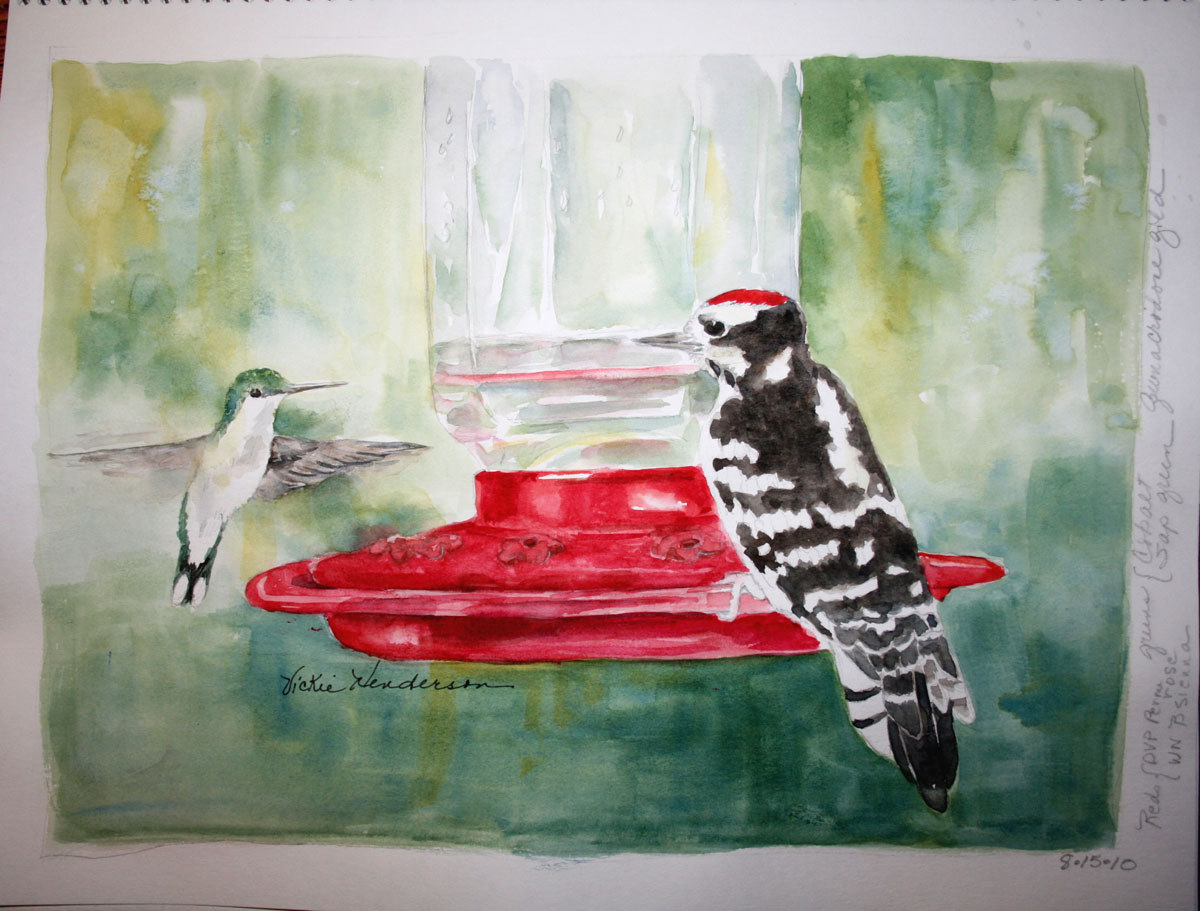
Hummingbird and Downy Woodpecker on Nectar Feeder
If you love nature and you love to recreate what you see and experience in watercolor, there couldn't be anything more fun than diving back into a subject and watching it come to life in a painting. When it comes to birds, that could also mean tripling and quadrupling your fun!
It has been fun on top of fun to hear and witness this male Downy woodpecker visiting my nectar feeders intended for tiny hummingbirds. But top it off with interactions between the two species and smiles just keep coming.Painting this sketch had the same effect. I smiled a lot. And when you're smiling there is no worry about outcome. You're just loving your subject and loving the opportunity to give it center stage. And there's a number of ways to create that stage, among them, painting light against dark, soft against hard, and color that leads the eye through the painting. I often approach these elements intuitively
I chose my background colors in this sketch first, focusing on the greens of the trees and the light in the spaces in the unfocused background. A principle I learned from my long-time watercolor mentor and instructor, Ann K Lindsay--the fewer colors you use, the more unified your painting. I've found this to be excellent advise that stuck with me and greatly simplifies decisions!
In this sketch my primary colors are DVP Cobalt Blue , WN Quinacridone Gold for my yellow, and DVP Permanent Rose for my red. (Note: brands with the same color name vary in actual color. WN stands for Winsor & Newton brand paint, DVP for Da Vinci). The rest of my colors consisted of two neutrals and sap green, all used to alter the shades of the above three primaries: DVP Sap Green, to add a little warmth to green made with the gold and blue; WN Van Dyke Brown, used with cobalt to make black; WN Burnt Sienna used with rose to warm it. I also use burnt sienna with blue to make grays, adding a touch of the other colors on the palette as needed.
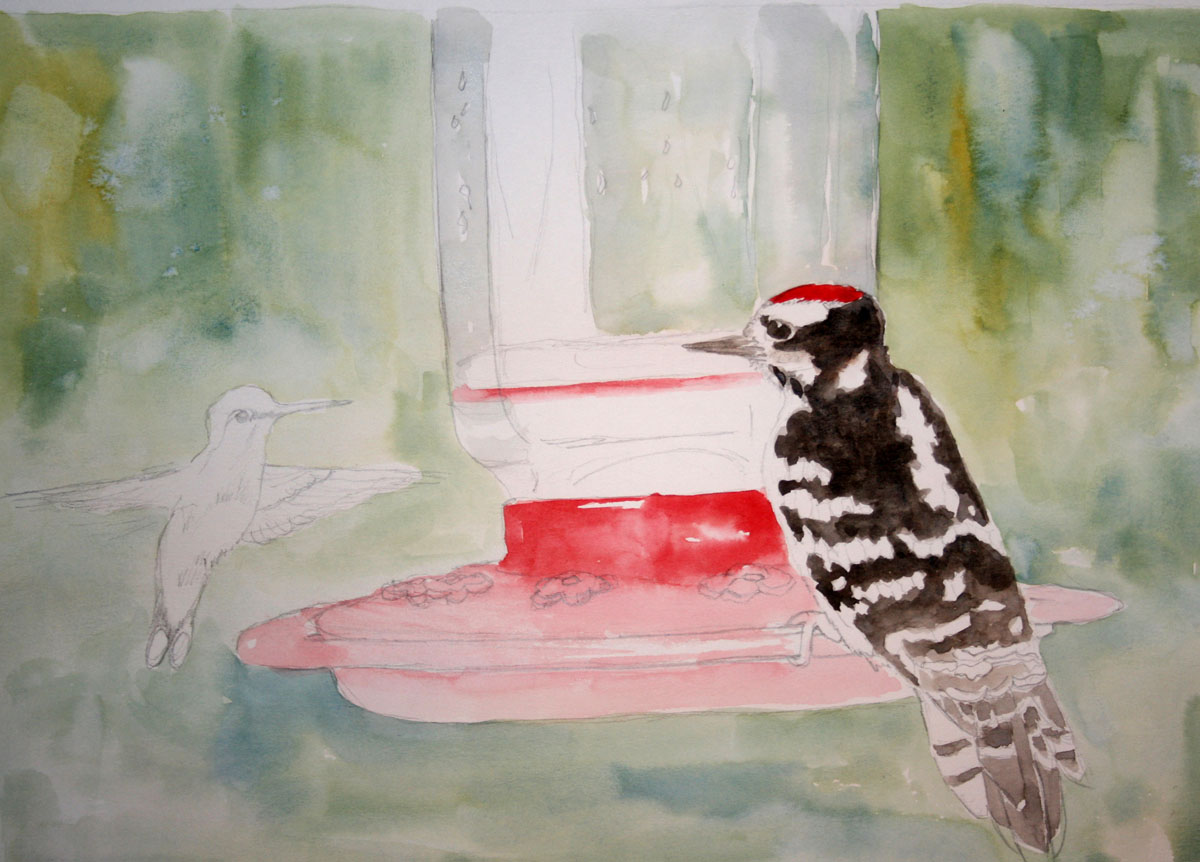
As I'm working on the light washes, I'm making a map of sorts. I'm aware that my hummer and the water in the feeder will both be the same colors as the background. This means I have to draw the viewers eye to my subject with the placement of values, that is, the positioning of darks and lights. At this point (above), I also add color to the nectar container which reflects the background, and to the water in the feeder as a reference for these values. The water and the feeder represent my lightest lights.
The hummer is next, creating wings that have a fairy-like movement of 40 to 80 beats per second.

To soften edges on the hummer's wing, I laid down paint strokes, rinsed my brush, blotting excess water from the brush with a sponge or paper towel, then brushed along the edge of the paint. The paint edge is softened by the moisture from the brush. The amount of water you leave in the brush controls how far the pigment will spread from the original line.
One way to suggest hummer wing movement is illustrated below--a combination of disconnected shapes, blurs, a mix of hard and softened lines.
Below is the almost finished sketch, created in one of my favorite sketchbooks made by Aquabee, on 11 x 14 paper. What made me realize it wasn't quite finished was a glimpse at an LCD image on my camera that highlighted the widely separated gold areas.
The yellow in this sketch is like an accessory with a special function. It either helps move the eye through the painting or it distracts, especially since there is no yellow in my two stars. So, I added yellow to areas where 'my eye wanted to see yellow', moving left to right from one side of the painting to the other, dabs of yellow glaze leading through the two birds. You may already know how this dictate-from-the-eyes feels. It's a sensation that is visually uncomfortable, that is, it bothers until the correction is made. And when it's right, you know it--your eyes are happy again. See what you think by comparing the finished sketch below to the one above.
In bird-watching, the intuitive ability to identify a bird by its shape and movement is referred to as 'jizz'. It's a wholistic and instant recognition. It's learned. Painting works the same way. Besides helping you learn the skills of manipulating water and pigment on paper, practice develops jizz, your eye's intuitive ability to know what your painting needs in order to please you.
Friday, August 6, 2010
The Curious Wood Stork
Below you see a Wood Stork I sketched nine years ago. In fact, this was both the first time I attempted to record my travel experience in a sketchbook and my first sightings of Wood Storks. I had to get out my field guide to be certain of the species. I also didn't have my digital camera back then for reference images, so the sketch was created from my field guide and my memory, giving it a whimsical quality.
Sketchbooks are tons of fun, both creating them and looking back on them. They reflect the mood of the moment as much as the subject. Below is another Wood Stork sketch created this year. In this encounter, I had the fun surprise of seeing this bird standing close-up, near the road. When you are observing from a car, birds and animals are often undisturbed and may stay around allowing amazing looks.
My impression of this endangered bird--a bird draped in chiffon-like plumage topped off with a head full of wrinkles and scales. What a combination. When I looked at my photo images later, all I could think about was the fun I would have sketching him! And while I was sketching all those scales and wrinkles on his head, I wondered more and more what this characteristic was all about.
To create this sketch, I experimented with masking fluid to save the feathery edges of the plumage and used a disposable skewer to make the lines. This avoids soaping a brush to prevent the bristles from sticking together and also solves some of the challenge of making fine lines. But even with a sharp tipped skewer, the fineness of the line takes some practice. After dipping the stick in the fluid, droplets form on the tip. What worked for me was to place the drop of fluid in a large area and drag a finer line of liquid to the edge of the feather.
Since rubbery masking fluids deteriorate with exposure to air and lose their effectiveness over time, I've poured some into an old film canister, to lessen exposure to the original bottle, and labeled it with the type of mask and date. Have you ever picked up a bottle of mask and wondered how old it is? At least on this bottle, there was no date anywhere. Masks are said to have an effective life of approximately one year after they're opened.


A light scrub and a new crown line and the problem was solved.
Sketchbooks are tons of fun, both creating them and looking back on them. They reflect the mood of the moment as much as the subject. Below is another Wood Stork sketch created this year. In this encounter, I had the fun surprise of seeing this bird standing close-up, near the road. When you are observing from a car, birds and animals are often undisturbed and may stay around allowing amazing looks.
My impression of this endangered bird--a bird draped in chiffon-like plumage topped off with a head full of wrinkles and scales. What a combination. When I looked at my photo images later, all I could think about was the fun I would have sketching him! And while I was sketching all those scales and wrinkles on his head, I wondered more and more what this characteristic was all about.
To create this sketch, I experimented with masking fluid to save the feathery edges of the plumage and used a disposable skewer to make the lines. This avoids soaping a brush to prevent the bristles from sticking together and also solves some of the challenge of making fine lines. But even with a sharp tipped skewer, the fineness of the line takes some practice. After dipping the stick in the fluid, droplets form on the tip. What worked for me was to place the drop of fluid in a large area and drag a finer line of liquid to the edge of the feather.
Since rubbery masking fluids deteriorate with exposure to air and lose their effectiveness over time, I've poured some into an old film canister, to lessen exposure to the original bottle, and labeled it with the type of mask and date. Have you ever picked up a bottle of mask and wondered how old it is? At least on this bottle, there was no date anywhere. Masks are said to have an effective life of approximately one year after they're opened.


This sketch also reinforced the practice of walking away from the table for a while, sometimes overnight, to discover what fresh eyes will see. In this case I noticed that the placement of the eye didn't look right. A closer look and I realized the problem was the height of the crown.
A light scrub and a new crown line and the problem was solved.
Saturday, May 8, 2010
The Hardest Thing About Sketching is Time
I've just returned from a fun and exhilarating nature festival at the New River Gorge in West Virginia--the New River Birding and Nature Festival. This is a beautiful place and this time of year, it's a place alive with migration and beautiful wood warblers settling into their nesting territories on mountain ridges.
Time was at a premium while there. Briefly described, my mornings began at five a.m. and if I had two hours for rest in the afternoon, I was lucky. When the day was done, you were ready to fall into bed and the next morning, you were up and on your way to your next adventure.
When you participate in a festival of this sort, you learn so much, your eyes are opened wider, your senses are keenly alert. Birding is about habitat, about song and about finding the bird, whether with your naked eyes, binoculars or a scope. You're with experts that can help you do this and I for one, wanted to take advantage of every minute of it.
And this is also a time for learning a lot about yourself, your personality type, your comfort zone. I'm a turtle! That best describes it. I want to soak it all in slowly. I understood after a day or more of rest, why my mind was in such a fog when I returned home. Thank heavens for notes, photographs and my handy reference books on my shelf. Because, I want to remember it all. I want to absorb it and integrate it and never forget it. And I want to sketch it.
Not only is a sketchbook a record of what you see and feel about your journey, it helps you to integrate information that otherwise has been acquired at a fast pace. Sketching is a time to absorb it all, remember it and relax as you let your mind play it back for you and recreate it on the page.
There were several times I wished for more time and my sketchbook--while viewing Kanawha Falls, sharing a picnic on boulders beside the Gauley River or while examining a beautiful Jack-in-the-Pulpit. Time is at a premium every day of our lives. And because sketching deepens my pleasure and the depth of what I've enjoyed, as much as I can manage it, it will continue to be an important part of my experience, whether before, during or after!
The above sketch was created in my sketchbook, watercolor (and ink on the bridge) on 90# coldpress Arches paper.
Time was at a premium while there. Briefly described, my mornings began at five a.m. and if I had two hours for rest in the afternoon, I was lucky. When the day was done, you were ready to fall into bed and the next morning, you were up and on your way to your next adventure.
When you participate in a festival of this sort, you learn so much, your eyes are opened wider, your senses are keenly alert. Birding is about habitat, about song and about finding the bird, whether with your naked eyes, binoculars or a scope. You're with experts that can help you do this and I for one, wanted to take advantage of every minute of it.
And this is also a time for learning a lot about yourself, your personality type, your comfort zone. I'm a turtle! That best describes it. I want to soak it all in slowly. I understood after a day or more of rest, why my mind was in such a fog when I returned home. Thank heavens for notes, photographs and my handy reference books on my shelf. Because, I want to remember it all. I want to absorb it and integrate it and never forget it. And I want to sketch it.
Not only is a sketchbook a record of what you see and feel about your journey, it helps you to integrate information that otherwise has been acquired at a fast pace. Sketching is a time to absorb it all, remember it and relax as you let your mind play it back for you and recreate it on the page.
There were several times I wished for more time and my sketchbook--while viewing Kanawha Falls, sharing a picnic on boulders beside the Gauley River or while examining a beautiful Jack-in-the-Pulpit. Time is at a premium every day of our lives. And because sketching deepens my pleasure and the depth of what I've enjoyed, as much as I can manage it, it will continue to be an important part of my experience, whether before, during or after!
The above sketch was created in my sketchbook, watercolor (and ink on the bridge) on 90# coldpress Arches paper.
Saturday, April 3, 2010
A Turkey Work of Art
That's how I feel about turkeys lately, works of art parading through my yard.
Certainly not the prettiest art by some standards, unless you're a turkey, but definitely faces with character, prehistoric character. Everyone of them is uniquely decorated with expression and with those curious skin enhancements, especially the sub-adult males in the "jake" stage.
Jake is a new term for me (an immature tom), along with snood, caruncles and dewlap, all descriptive terms for various parts of the turkey anatomy, that I discovered while researching the difference between young and mature, male and female. I found a nice anatomy reference on the Wild Turkey Federation's website (link below).
In general females have feathers on their heads while males do not. The males develop a bald head that appears whitish in the mature tom, with reddish skin enhancements that increase as they mature. The major caruncles extend down their neck and these folds of skin become bright red and engorged with blood while courting. Females have some skin enhancements also, but they are generally smaller and bluish making her overall appearance camouflaged while incubating.
According to my Atlas of the Breeding Birds in Tennessee, males establish territories in late winter here and hold them throughout the spring with egg-laying peaking during the last two weeks of April. I'm mostly seeing females and immature males. It does make me wonder where male territories would be around this suburban area, with its pockets of agricultural fields and wooded ravines.
If I see a male displaying, you'll be the first to know. That would definitely fall into my idea of art!
Certainly not the prettiest art by some standards, unless you're a turkey, but definitely faces with character, prehistoric character. Everyone of them is uniquely decorated with expression and with those curious skin enhancements, especially the sub-adult males in the "jake" stage.
Jake is a new term for me (an immature tom), along with snood, caruncles and dewlap, all descriptive terms for various parts of the turkey anatomy, that I discovered while researching the difference between young and mature, male and female. I found a nice anatomy reference on the Wild Turkey Federation's website (link below).
According to my Atlas of the Breeding Birds in Tennessee, males establish territories in late winter here and hold them throughout the spring with egg-laying peaking during the last two weeks of April. I'm mostly seeing females and immature males. It does make me wonder where male territories would be around this suburban area, with its pockets of agricultural fields and wooded ravines.
If I see a male displaying, you'll be the first to know. That would definitely fall into my idea of art!
Subscribe to:
Posts (Atom)
Ocean Trail at Rancho Palos Verdes Preserve, California--2015
Joshua Tree National Forest, California, with son Chad and daughter Thuan--2015
Photo credit: Thuan Tram
Bird banding with Mark Armstrong at Seven Islands State Birding Park - 2014
Photo courtesy of Jody Stone
Birds Close-up
Photo courtesy of Karen Wilkenson
Enjoying Gray Jays in Churchill, Manitoba
Photo courtesy of Blue Sky Expeditions
A dog sled experience with Blue Sky Expeditions, Churchill, MB--2014
Photo courtesy of Blue Sky Expeditions
Churchill, Manitoba--2014
Photo courtesy of Blue Sky
2014 Hummingbird Festival
Photo courtesy of Jody Stone
Smithsonian National Zoo with one of my Whooping Crane art banners and son, John--2014
Muir Woods on the Dipsea Trail at Stinson Beach, California--2014
Photo courtesy of Wendy Pitts Reeves
Checking out the gulls at Stinson Beach--2014
Photo courtesy of Wendy Pitts Reeves
Discovery Hike in Denali National Park and Preserve, Alaska--2012
Photo courtesy of Ruth Carter