Showing posts with label inspiration. Show all posts

Sunday, April 3, 2016

One Decision at a Time

I have been blogging since January of 2008--eight years!  Google sent me an email message today saying some of my links on Vickie Henderson Art are not working and I should clean them up.  Good idea.  In doing so, I ran across this early post published April 1st, 2008.  I love the message.  I am astounded that I still paint this way.  Its wisdom lives on!  

One decision at a time, a painting is formed.
One decision at a time, a life is lived.
The name of this painting is “Pink”. It began as a wash of pigment brushed on wet paper with nothing in particular in mind, except to see what a bit of rock salt sprinkled here and there would create. The next step was to define something, a shape, a form, a suggestion. The first time I tried this, I struggled. My mind was blank. I saw nothing. Nothing came to me, except frustration and the feeling, maybe I can’t do this. Maybe I hate this.

I revisit that place from time to time, where desire and doubt butt heads. Desire wins out with a little perseverance. And the next thing I know something magical has happened and I created it—me and the water and the pigment and the Universe--one decision at a time.

Sunday, August 9, 2015

Art Workshop with Brenda Swenson--Skill-building, Inspiration and Community!

We are all students and always will be as long as our minds and hearts remain open and curious. Art workshops provide creative opportunities to not only learn new skills but also rub shoulders with other artists and gain new ideas, encouragement and inspiration.
Negative painting practice after the workshop.

Brenda Swenson in Boone, NC

I had the delightful experience this past week of visiting Boone, North Carolina, for a five-day "Sketching in Watercolor" workshop hosted by Cheap Joe's Art Outlet, featuring award-winning artist, Brenda Swenson.  I admire her watercolors and sketches and couldn't pass up the opportunity to learn from her when I discovered she was visiting the east to give a workshop.

Porch outside the class room--a place to retreat for breaks or to enjoy lunch. 

Each day of the workshop we practiced drawing skills that will help us paint a subject from life. The first skill practiced, and our warm-up practice for each day, was continuous line contour drawing--drawing with a continuous line without lifting your pen.  And yes, pen, not pencil.  No erasing or correcting.  We were encouraged to slow down and "see", and yet, each drawing had a time-limit and a timer running to keep our hands and minds moving.  Three minutes were allowed for one object, six minutes for two objects, and nine for three.  The objects were household items or "junk", any vase, tool, figurine, pitcher, anything that might be laying around the house or garage.
Above, a class exercise--combining elements from more than one photograph to create a sketch composition. Tombow water soluable burnt sienna pen with watercolor on Canson multi-media sketchbook paper.

The daily warm-ups accomplished so many things.  Practice in concentrating, accepting the wobbles in our drawings, awareness of time, moving continuously without getting stuck on any one area, focus, and just getting it down no matter how imperfect.  In fact, one of the mottos of class-- "perfect is boring".  What we found as we looked at each other's work was that the wobbles contributed to the uniqueness, charm and style of each drawing.
Above, members of our class waiting to have our work critiqued.  (I'm third from the left in the front row).  Photo credit:  Brenda Swenson

We learned as much from our critiques as we did from the art exercises and they were fun! Everyone's art is different and the variations in style and creativity are exciting.  Brenda pointed out positives in each work and gave suggestions for improvements, providing great visual examples to aid memory.
For example, the white cloud in my sketching practice on tinted paper (above) was created with opaque paint.  After pointing out the vignette design and how the light travels through the color of the tinted paper through the columns, Brenda mentioned that the white cloud wasn't needed.  I looked at it later and realized that the cloud is not only not needed, it draws the eye away from the main subject which is the lovely columns.  This is the value of practice and having someone else critique your work.  We're often too close to our own work to be objective.
The continuous line contour drawings felt awkward to me, at first, and I initially wondered why I ever thought I could draw!  Drawing is a skill that becomes rusty when not used!  For me the additional challenge was a combination of new tools and the timer.  With a timer going, I couldn't obsess about the details.  I couldn't erase!  This represented a huge leap forward.  I have wanted to sketch as I travel but the stopper has always been "too little time".  The skills we practiced were the very ones I needed to create possibilities for sketching in all types of circumstances.
 Above, Brenda Swenson demonstrates her negative painting technique.
In the classroom, a video camera was mounted to project the art demonstrations on a large screen so that while seated, members of the class could view the demonstrations.  The images above and below are pictures of the screen during the demonstration.
Delicious catered lunches were enjoyed daily and for the eager student, Cheap Joe's art supply store was right in the next room open for business!  Add a skilled and patient instructor to the mix and you have the ingredients for an ideal art vacation!
Tennessee artist Kay Alexander (left), Brenda Swenson and Vickie Henderson in Boone, NC.

Resources and information:

Brenda Swenson's website
Brenda's blog
Kay Alexander's website
Cheap Joe's Art Supplies

Saturday, October 8, 2011

Part II--A Book, A Teacher, and Intuitive Learning

Have you ever wanted to do something so badly, that you were equally afraid you couldn't?  That pretty much sums up how I felt about becoming an artist.  And just to set that worry straight for any readers that feel something similar, if you love art and have always wanted to draw or paint, you already are an artist.  The becoming part is simply a matter of becoming familiar with the medium and developing skills through practice.  
Even though I was disheartened by my initial class, my interest in watercolor did not lessen.  I browsed the local art store for books and magazines to aid my attempts to paint.  It was during one of these visits that I found the treasure that shaped my art endeavors for the next ten years, a book called, Watercolor:  A New Beginning, by Ann K. Lindsay.
I opened the book while still in the store, as we often do, to leaf through it to see what it had to say.  I found topics like, "Being of Two Minds", describing the rational vs. the intuitive mind and how these two parts of our brain learn and approach things differently; "Managing Your Inner Critic" suggesting ways to manage your inner fear and why that critic develops inside; and, "Just in Case", addressing feelings of fear and resistance while trying demonstrations in the book.  Ann writes:  "Art is our heart coming right out of us onto the paper, into the world; no wonder we feel so vulnerable and easily discouraged".
This was the book and the instructor I had been looking for.  In the book, I found step-by-step instructions that actually started at the beginning with putting paint in the palette, suggesting inexpensive ways to get started.  Subsequent chapters demonstrated ways to play with pigment and water on paper, covered the basics on colors explaining primary, secondary, tertiary and neutral colors, and progressed to painting a subject using values with tips on drawing, and adding backgrounds to your paintings.
Exploring how different pigments react to salt.

This book, with its nurturing and encouraging approach, gave me the courage to feel excited about watercolor, again. So excited in fact, I traveled from east Tennessee to upper state New York the next summer, in 2000, to take what I consider to be my first watercolor class, this time with Ann Lindsay. This journey was an adventure and magnificent in so many ways. But most of all, I want to say a little more to you about that tenderness we feel as beginning artists, a feeling that can often hold us back.
Even in the gentle and nurturing environment of a class of true beginners with an intuitive and mindful instructor, my first attempt to put my art out into the world in that first day of class was truly frightening.

In my journal I wrote:
July 31st, 2000:  [Monday--day one] "I had a panic attack--throat closing, flushed, tears--over the show-and-tell thing we did after the first exercise today.  How could I be self-conscious, uneasy over splashing color and water on paper in no particular pattern? It is beyond my understanding sometimes, what sets off my anxiety."

August 4th: [Friday night, as the week of classes ended] "I have enjoyed this tremendously....Ann says, art is the soul coming out on paper. Maybe that's why this art is so very sensitive an issue for me. There aren't too many ways that I share my soul with others....When I shift to expressing who I am inside, talk about me, whether in a novel or a watercolor or sketch or photograph, that is a very sensitive moment. I feel vulnerable and exposed. Hence, my panic attack on the first day of class. It was less about what we were looking at, what I had created on paper, and more about how much I have always wanted to do this."

And to all of you artists out there--keep painting!

Links and Resources:

Part I to this post:  Books, A Difficult Start and A Passion for Watercolor

Monday, September 26, 2011

Books, A Difficult Start, and A Passion for Watercolor

I love books in general, but art books rank high on my list these days.  Though I've had some of the books you see for a while, in the absence of time and opportunity to travel away from home to take art workshops lately, I've added a few more to my shelves as a way of making sure there is plenty of creative stimulation available for art practice.  
Why do I travel away from home to take workshops, you might ask?  Because, along with the opportunity to learn from a talented instructor, I get the advantage of a vacation-like atmosphere that is nurturing, focused on something I love, and that takes me completely away from my day-to-day responsibilities.  It is similar to the renewing affect of vacations in general, but with the added benefit of time solely devoted to watercolor play and the extra stimulation of a talented instructor and creative community energy.  In fact, a special book and travel to an out-of-state watercolor workshop set the stage for my journey into watercolor after serious beginner discouragement.

I came into the world loving art and drawing, but watercolor was not a medium I was exposed to at a young age.  I just admired it greatly.  Obviously the desire to create art was re-kindling in me in 1999. My time and energies had been caught up in volunteer writing for professional projects in the years preceding.  But as I freed myself from those responsibilities, my urge to return to art strengthened and I signed up for a local "Drawing on the Right Side of the Brain" workshop.  
I was nervous early in those class sessions, as though I had lost all confidence in my drawing ability and needed someone to tell me I could still draw after so many years of neglect. Above and below, you see portraits that I sketched in class.  They were drawn from photos turned upside down, a maneuver that encourages the artist's brain to stop thinking in symbols (drawing what you think should be there) and to see the linear and spacial relationships more clearly.  This was heartening and amazing, both to see my own drawings, and the others produced by people who had never attempted to draw.  
Encouraged, I ventured into my first watercolor class, a weekly three hour class of "multi-level students, from beginners to advanced" held at a local art supply store.  I was the only beginner in the class.  The other students had taken from this instructor previously, had wonderful things to say about her, and had sophisticated projects already underway.  I don't think the instructor was prepared for a person at the very basic beginner level like me, one who had not quite grasped how one was supposed to arrange tube paints in the palette and mix them with water.
Above, four value studies varying placement of dark and light values.  A bit of a mess.

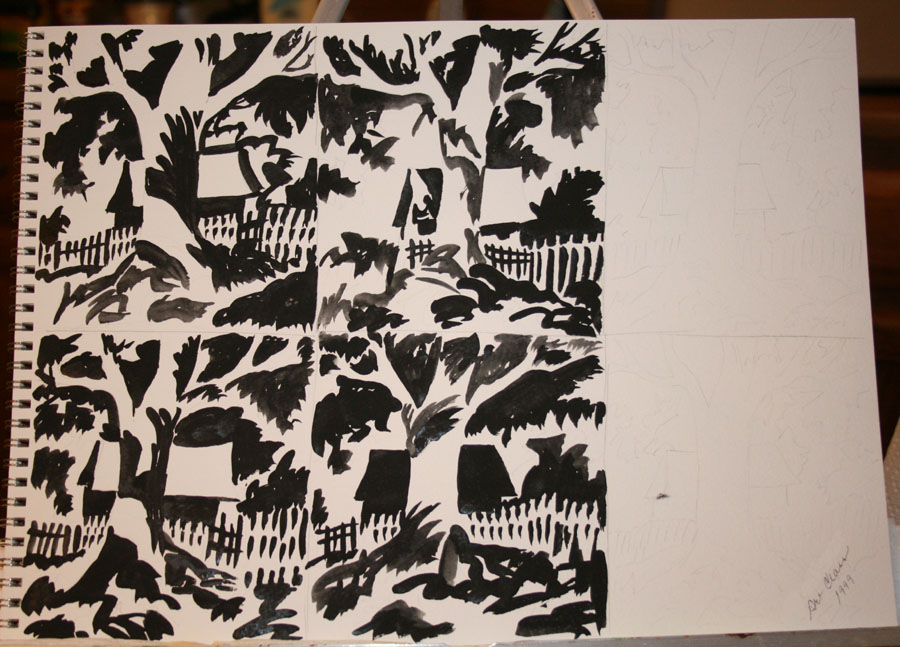
The class turned out to be a disaster for me, though in hindsight, I'm glad I had this experience. Perhaps because she had run out of suggestions for what I should do next, in the last hour of one of my classes mid-way through the course, I was instructed to create the value studies you see above, varying the placement of dark and light with each repetition. Without any introduction to values and how they are used, I not only failed to understand the point of this exercise, I felt like the child who'd been sent to the corner to do busy work.  Needless to say, this was not fun. I came away from the experience so bored and bewildered that I did not finish the classes. I closed my palette, concluded I couldn't do watercolor, and didn't open my palette again for another year.

It is this type of experience, technique before play, that often leads people to believe that watercolor is such a difficult medium. It's not. It's delightful, fun and easy to love!

Next: Reviving my watercolor passion--A Book, A Teacher, and Intuitive Learning

Friday, June 17, 2011

The Richness of Watercolor--It's Interaction

11 x 14 watercolor, Monarch on White Crownbeard.
Watercolor is rich in it's versatility, in the many different ways you can approach a subject while attempting to capture the interplay of color and light. I suppose that is true with any medium, but watercolor moves as you paint and that quality gives it a richness and a freshness that is always full of surprises. I think it is this interaction, between the pigment and water, that always stirs in me the desire to explore it more. Each time I paint and see the results, I want to try again, see what other ways I can find to express what I'm seeing and feeling.
I painted this monarch primarily from a sketch in my sketchbook. While painting, I relied chiefly on the sketch rather than reference photos or having the subject in front of me. It is a different experience, a freeing experience. Sketches always feel lighter to me, free from the tension that painting a "real" painting sometimes causes.  It is wonderful practice and a wonderful way to keep your painting fresh.  There is a looseness in sketching that comes from the fact that you know it's practice, there's no pressure.  You're uptight left brain goes to sleep, after all, you can easily start over again.  And there is a practical limit to the amount of detail you can capture or even want in a sketch.  In fact, the lack of detail is the magic of a sketch.
Having said that, I love detail.  It is part of my fascination with nature and is one of the reasons I enjoy studying my subjects with my camera.  The camera brings the subject closer, allowing me to slow down the activity so I can learn more about what's happening.  And what I discover never fails to delight me.  But a painting is more than just a rendition of the subject in its environment.  A painting is also an interaction.  
This interaction is one of the most intriguing and challenging aspects of watercolor. There are the primary interactions that we are all familiar with, between pigment and water, paint and brush, and of course, between the visual reality and what the artist sees and feels. But there is also the important interaction the viewer has while viewing the art. When the viewer sees the final work, we, as artists, hope they will be inspired.
For me, the delight and inspiration of watercolor is stirred by that mysterious quality in its movement.  Using a photograph for reference, as I often do, can sometimes suck me into detail, which can result in a tight rendition rather than an image that is fluid. This is what I noticed as I worked on this painting.  The sketch freed me to just paint, to focus on what I found to be beautiful about the subject, to stay with the light and airy quality of both the butterfly and the flowers, leaving the details more to the imagination.
It is this stimulation of imagination that is the root of inspiration.  As creative beings, we love feeling this.  And when my painting is finished, it is this inspiration that I want others to feel right along with me.

Wednesday, February 2, 2011

Watercolor Painting--A Reflection of Life

I've been approaching painting one-hour-at-a-time lately.  This is not my favorite way to paint.  I much prefer to dive in and lose my sense of time, enjoying the painting as it unfolds and remaining in that trance-like state for hours.
Of course, you can create the same effect in a smaller amount of time by making "smaller" decisions.  What you do next is on a smaller scale, covers a smaller area, or simply consists of fewer strokes of paint.  And there is an up side to painting this way.  You have plenty of time to think about what you want to do next, loading your library of options so they'll be ready the next time you sit down to paint..
Besides time, there are a couple of other things that enter into this dance we call painting--mood and inspiration.  My mood has waxed and waned tentative lately.  It is easy for me to identify one reason.  I have been actively participating in a conservation effort over the past few months, one that required many hours of research, writing and consideration--an effort underway to hunt the eastern population of sandhill cranes, a population that was nearly extirpation just 70 years ago.  Conservation controversies are intense, full of conflict and, inevitably, cause us to dig deep into our inner resources. 
All of the above stimulates changes in mood, from concern to fear and hesitation, to anger, back to tentativeness, and finally to the boldness and determination that leads to decision and action.  Now that's a bouncy ride for any person's mood.  It is hard to paint with all that going on.  But painting can add balance, a quiet introspection and reflection that can be very beneficial.
As the conservation issue was unfolding, the above sandhill crane image that I took in the waste grain corn fields of Bosque del Apache National Wildlife Refuge in New Mexico kept coming into my mind.  A male crane was boldly displaying to another male, establishing his family's feeding territory.  It's hard to imagine there are territories with so many cranes in the same field, but once they are established, these carefully claimed boundaries provide order while families feed together.
This behavior and this image gave me inspiration.  It symbolized the attitude that I needed to go forward with conservation efforts.  And partially because it contained that kind of meaning, I've approached it tentatively.  I've said to myself many times, how are you going to do this?  What are you going to say about that background?  (The image has little variation in light and values.)   How are you going to enhance the subject with these colors?  And, as I have observed to myself many times while working on both the painting and the conservation issue, I don't know the answers.  I just know I need to show up.  One decision at a time, one hour at a time, I'll move forward and the painting will happen.  So, also, the conservation.  


Ocean Trail at Rancho Palos Verdes Preserve, California--2015

Ocean Trail at Rancho Palos Verdes Preserve, California--2015

Joshua Tree National Forest, California, with son Chad and daughter Thuan--2015

Joshua Tree National Forest, California, with son Chad and daughter Thuan--2015
Photo credit: Thuan Tram

Bird banding with Mark Armstrong at Seven Islands State Birding Park - 2014

Bird banding with Mark Armstrong at Seven Islands State Birding Park - 2014
Photo courtesy of Jody Stone

Birds Close-up

Birds Close-up
Photo courtesy of Karen Wilkenson

Enjoying Gray Jays in Churchill, Manitoba

Enjoying Gray Jays in Churchill, Manitoba
Photo courtesy of Blue Sky Expeditions

A dog sled experience with Blue Sky Expeditions, Churchill, MB--2014

A dog sled experience with Blue Sky Expeditions, Churchill, MB--2014
Photo courtesy of Blue Sky Expeditions

Churchill, Manitoba--2014

Churchill, Manitoba--2014
Photo courtesy of Blue Sky

2014 Hummingbird Festival

2014 Hummingbird Festival
Photo courtesy of Jody Stone

Smithsonian National Zoo with one of my Whooping Crane art banners and son, John--2014

Smithsonian National Zoo with one of my Whooping Crane art banners and son, John--2014

Muir Woods on the Dipsea Trail at Stinson Beach, California--2014

Muir Woods on the Dipsea Trail at Stinson Beach, California--2014
Photo courtesy of Wendy Pitts Reeves

Checking out the gulls at Stinson Beach--2014

Checking out the gulls at Stinson Beach--2014
Photo courtesy of Wendy Pitts Reeves

Discovery Hike in Denali National Park and Preserve, Alaska--2012

Discovery Hike in Denali National Park and Preserve, Alaska--2012
Photo courtesy of Ruth Carter
Related Posts with Thumbnails