Saturday, March 21, 2015

Bluebird on Ice--an Exploration

"Watercolors are not for the faint-of-heart but for those willing to explore and experiment, knowing that they risk failure, knowing that each piece of paper will not end as a 'masterpiece'....So long as you keep rising to its challenges, it will keep opening doors on others.  In time watercolor will become a reflection of you and your personality".  Gordon MacKenzie, The Complete Watercolorist's Essential Notebook.
This painting became one of those lively challenges.  A practice in patience and decision-making that stimulated my desire to learn new skills and new ways to indicate sparkle in a winter scene.
My first challenge was saving whites w/o using a masking medium by painting around the iced limbs. My hope was to capture the bright, muted grays of this winter day illuminated by a coating of ice and snow.  Even though an initial wash of "painting around" objects looks a bit awkward at this stage, its appearance changes as you add more elements to the painting.  I used French Ultramarine and Burnt Sienna (Winsor Newton brand) to mix the gray, adding more water to achieve a lighter shade.
The gray wash was painted on after wetting the paper and being careful to leave the iced branches dry.  The paint will move around the dry area.  Once the wash had dried, I added more limbs and the brighter colors on the bluebird.  The blue feathers are created from a mix of Pthalo Blue and Cobalt Blue.
Next I added the red berries and more limbs.  I added darker gray around the limbs below the bird but discovered I preferred the brighter gray and corrected this by spraying clear water on the darker areas to dilute the color.  
In the image above, the iced limbs draw the eye to the white and the hard edges. Below, I have softened some of the edges of the ice and added limbs showing through.  
I continued to soften the ice edges by lifting with clear water and a scrub brush and softened the lines of the limbs within the ice.  I've also added drips to further create the impression of ice and added more detail to the berry pods and the bluebird, shown below.
This was a fun exploration and a good practice for the patience of letting things unfold. Since working on this painting, I have searched for ideas in my watercolor books and found demonstrations on creating the sparkle and reflection in a crystal vase, which is somewhat like ice, and creating sparkles and ice on the surface of water.  Though I haven't come across a demonstration of ice on branches, these techniques will come in handy as I continue to explore this kind of winter scene.  
The last three weeks of February gave me plenty of reference images for ice on branches here in Tennessee.  Below is another image of a bluebird on an iced branches.  In this image, the limbs are clearly visible beneath the ice and you can see small reflections.  This maybe my next painting challenge!
Previous posts on Eastern Bluebirds 
Painting Ice
Softening edges
Visit my blog posts on birds in ice at Vickie Henderson Art to see more images of birds on ice.

Monday, March 16, 2015

Painting a Bluebird on Ice

One of the many helpful insights I've learned over the years is this simple concept: "Every painting is created one decision at a time." All you have to do to move forward is decide what one thing you want to do next.
That concept takes so much of the hesitation and intimidation out of painting.  Even if I can't "see" my way to the end, all I have to do is make one decision. And then, make one more decision after that.  Each decision builds on the next until the next thing you know, the painting is finished!

I had an idea of where I wanted this painting to go when I began.  I was interested in the ice and its impact on our wintering birds.  While ice coated everything, I watched the bird community change. New species showed up that were not normally at my feeders, and bird behavior changed as some species aggressively guarded their food source.  And right along with all this survival activity, the ice glistened on every limb, twig and blade of grass with an incredible hushed beauty.
I want to suggest that ice-glitter, the smooth ice formations around the burning bush twigs, and the hushed cold mood. I'm not really expecting to accomplish all of that in this first go-round, but I will learn from the effort! The first image you see is where I paused for a decision. The second image is the reference photo I'm using.

What would you do next? How would you begin if you were just starting this study? There are many ways to approach a painting and no one way is right or wrong. Feel free to use my reference image or one of your own and give it a try!

Bluebirds and Ice
painting decisions
learning as you paint

Monday, March 2, 2015

Winter Watercolor--Bluebirds and Ice

Just as we were thinking that spring was around the corner, winter decided to puff up and bring wintery precipitation of every form to east Tennessee.  In a matter of 24 hours we had an inch of sleet, freezing rain, snow, and artic air that plunged the temperature down to 4 F degrees, with lower wind chills due to the bitter wind.  
I spent a lot of time feeding and watching birds while ice glistened on every limb, sparkling like crystals when the sun came out briefly and creaking and popping as the wind brought the deep freezing cold front. Feeding bluebirds became a challenge.  
Bluebirds are special eaters--spiders, berries and fruits in the winter--they can't digest seeds. Larger birds suddenly became territorial--initially it was an American Robin, claiming all the berries for himself, and then a rogue Mockingbird moved in to claim every food source driving all the smaller birds away. Everybody was stressed!

I simultaneously worried about the survival of my bird friends and stood in awe of the dazzling beauty that surrounded them.  
Beauty is certainly one element that inspires our desire to create, but in this case, beauty juxtaposed with these harsh conditions tapped into that desire even more.  My mind immediately went to--how do I represent these beautiful ice-covered limbs in watercolor?

I'm just getting started with this exploration.  Creating a winter background, saving the white for the ice, getting that bluebird color and shape just right.  The only way to know how you will do it is to get started.  This process will result in either a valuable exploration or a painting.  Either way, the artist wins.
I decided to save the whites on the limbs by painting around them rather than using mask. Painting the subject next will help me see what else is needed as I go along.
Today, we're having a very dark, rainy mid-40's day.  I welcome it since the piles of snow that followed the ice disrupted a second week of work at my office.  There's always an upside, though. The incredible beauty that surrounded those wintery days, the influx of birds to my feeders with exciting wintering species like Fox Sparrows and Pine Warblers, and the added bonus of lots of inspiration for watercolor projects!  
Above is another painting in process that offered some different challenges--a light subject with a dark, textured background.  More about this painting soon.

Related Links:
Decision making -- the process
Chickadee in Snow
Bluebirds and Ice
Polar Bears sketching and my journey to Churchill

Monday, January 26, 2015

Winter Sketching

There is something about snow and the way it draws birds to the feeders that makes me want to step outside to sketch.  That was my urge on Friday (Jan 23rd) just after the snow stopped falling.  
34 F degrees is not exactly sketching weather but with gloves and a wool cap, I was okay for a while. Though a window view sounds warmer, had I been watching from indoors, I might have missed the big yellow tabby that came stalking and scattered all the finches.  A couple of hand claps sent him on his way.  
It's also likely I would have missed the chipping of the Hermit Thrush. He was chipping, wing-twittering and cocking his tail, all at the same time as I watched through my binoculars.  Cocking that rust-colored tail and letting it fall slowly is a characteristic behavior of the species and sometimes helps with identification.  
This Hermit Thrush likes to hang out around the feeders and every now and then, hop up on the suet plate to grab a crumb of home-made suet.  Quiet and secretive, he runs through the garden in starts and stops on dainty pinkish legs, hunting for insects.  At other times, like this one, he lands on a low-lying limb and makes thrushy chip notes in the shadows.

Winter brings a lot of fun birds and is a great time to watch for visiting species.  It's also a good time to practice fast sketching!  I lasted about 30 minutes!

Sunday, January 18, 2015

Polar Bears on the Hudson Bay

When to Use Your Camera:
When there's no time to sketch.  
When the subject is moving so fast that you need to freeze the action  
For intricate features, lighting or details
                  abrieviated from David Rankin's book, Fast Sketching Techniques

In David's book, he includes a few more reasons but I think the above are the ones I relate to the most.  I would add, "when you want to see more than your eye or your binoculars can reveal".
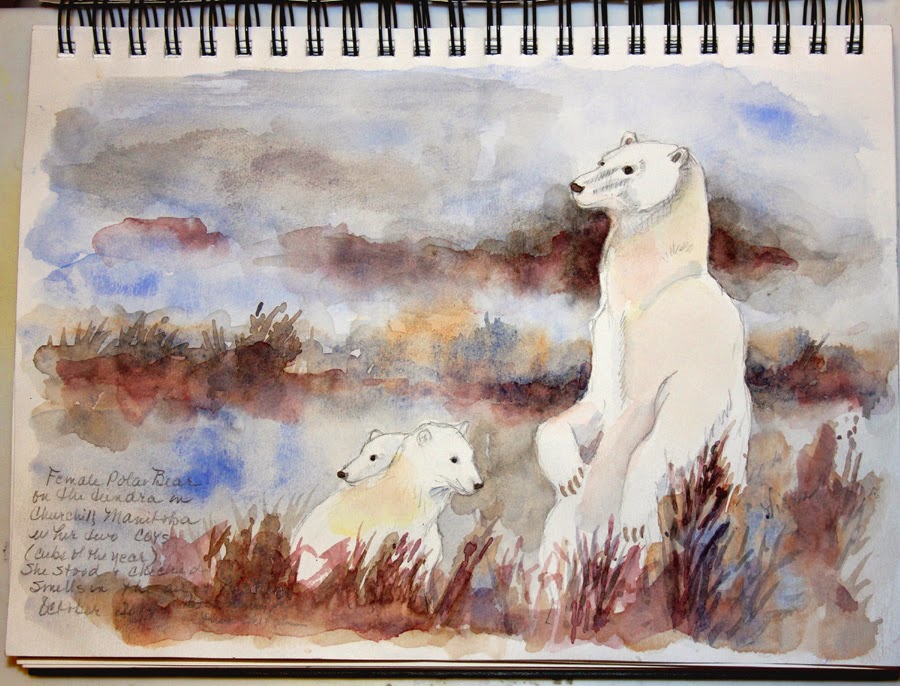
To my naked eye, and even through my binoculars, this beautiful female Polar Bear appeared to be simply walking, wandering through the tundra vegetation sniffing.  To my surprise, when I viewed an image taken with my 400 mm lens and zoomed in to take an even closer look, she was actually pulling and chewing grass.

I found this delightful.  Female Polar Bears fast during the summer and fall months, while they are denning and nursing their cubs.  They live off of the layer of blubber that they have stored beneath their black skin.  The blubber both insulates them from the cold and provides nutrition during months when there is no sea ice.  It also provides the fat-rich milk that nourishes their cubs.
My trip to Churchill, Manitoba, provided for only one day on the tundra.  I wanted to internalize that experience as much as possible and observe everything I could about the bears' behavior.  She slept. She nuzzled her cubs.  She moved slowly, conserving energy.  She stood upright to her full height and sniffed the air.  Her fur appeared soft and thick.  Her walk was a fluid movement--and though there is no known nutritional value for her, she chewed grass--while she and her cubs waited for sea ice to freeze on the Hudson Bay.  
My images remind me of what I experienced and are my guide to sketching. I'm still practicing these subtle bear shapes and enjoying the recall of watching this female with her cubs.
Polar Bears are marine mammals and carnivores, at home in the water as much as on land. They rely heavily on the ecosystem that nourishes ringed seals which in turn, provide the nutrition and blubber that Polar Bears require to survive.  Sea ice is vital to bear hunting, resting, warmth and breeding.

For more about Polar Bears and my journey to Churchill, visit Journey to Churchill at Vickie Henderson Art.

Click here for Part 1--Polar Bears on the Hudson Bay
Link to my Polar Bear video
Ecological Society of America
Ecological Applications report of decline of Polar Bears
Hudson Bay Buggies and Bears with Rail Travel Tours
Learn about Polar Bears
Hudson Bay
Eskimo Museum
History of Churchill from Churchill Science
Churchill History
the impact of sea ice decline

Sunday, December 21, 2014

Spruce Grouse Sketch

The nickname for Spruce Grouse is "fool's hen".  These ground-foraging birds are described as behaving as if they are tame.  The irony is Spruce Grouse inhabit northern coniferous forests in such remote areas that research on the species only spans about 30 years.   
On my recent trip to Manitoba to see Polar Bears in Churchill, I went birding with friends at Riding Mountain National Park and enjoyed a great experience watching a flock of grouse foraging.   We spotted six of them, a group of males and females.
Of course, they immediately scattered when we stopped, some running into the woods, others flying into spruce limbs.  The species' ability to remain still for long periods and the excellent camouflage quality of its plumage combine to help it avoid predators.
When a Spruce Grouse remains still, it is very hard to see, disappearing almost completely into the shadows of the environment.  As we stood still photographing the birds at close range, one by one they rejoined each other again as a flock and began foraging all around us.  The forest floor felt like a soft sponge under my feet, cushioned by peat moss and pine needles.  I felt as though I was walking with a group of tamed chickens as they pulled rose hips and berries off stems.  
This sketch included a lot of exploration and I immediately wished I had used watercolor paper.
The sketch is created on Canson 9 x 12 all media paper which is fairly strong but it won't take the changes that Arches cold press watercolor paper will tolerate.  The blue on the bird is ultramarine darkened with burnt sienna and sepia, although it looks more blue here than the actual sketch. Creating this sketch gave me practice in creating the suggestion of feathers, as well as, a review of mixing greens.  
I started out using ultramarine with arylide and the resulting greens were not cool or bright enough.  I like to use the same blues throughout, but I switched to phtalo blue with arylide to create the green and this combination was more to my liking and more closely resembled the colors of the flora on the forest floor.
I added a wash of diluted ultramarine blue as a layer over part of the background to help unify the yellows and greens with the blue in the main subject.  It also helped the sketch look less cluttered.
One of the many benefits of practice--if you've forgotten it, here's where you remember.  If you didn't know it, here's a safe place to discover it!

Wishing you a Happy Holiday season and hoping you will find some relaxing moments for sketching and painting!

To see more images of Spruce Grouse and read more about the journey that took me to see them, visit my blog posts on my journey to Churchill to see Polar Bears at Vickie Henderson Art.

Friday, December 12, 2014

Stretching Your Creative Mind

Some projects serve many purposes!  
I have never painted on this type of surface before--sleek, round, three-dimensional--nor used acrylic paints enough to know much about their qualities.  The surface of my gourd art is the only experience I could relate to this project, and that wasn't very helpful because of the difference in the surface.  As I began, it was one of those times I asked myself, "what were you thinking?!"

The request to decorate this ornament came from one of the park rangers at Seven Islands State Birding Park and the ornament now hangs on the center-peice Christmas tree at the governor's mansion among 56 ornaments contributed by our state parks representing Tennesseee's "landscapes and creativity" during this holiday season. Quite an honor.
The pull for me to say 'yes' and venture into this unknown territory--I love the park and spend many early morning hours there with the bird banding team.  Seven Islands became a state park in 2014 and Tennessee's first state park to be designated a birding park. By "unknown", I mean, I didn't know what the ornament was made of or its shape or texture until weeks after saying yes when I received it in the mail.
Since every artist goes through moments of doubt and mistakes when trying something new, I thought I would share a note I wrote in my journal while working on the ornament.

6:08 a.m. "I have so much resistance to starting when there is a deadline and someone else to please--otherwise, I can discard what I don't like.  It's the "have to get this done and it has to be good" pressure that keeps me frozen.  (12:30 p.m. the same day.)  Well, it's happening as I feared--it is a total mess.  I just stuck the ornament under the faucet and scrubbed off all the paint and then watched an acrylic blending video online and also read some more info about using acrylics.  I awoke too early and I'm tired.  I'm stuck but I need to finish this.  This ornament is making writing my book feel easy by comparison!  Now, what I really need to do is focus--one decision at a time--choose one background color, sketch the bird, use my watercolor pencil to divide it into sections, mark the horizon line.  I'm determined to do this horizon thing..."
Something else important happened along with the scrubbing off paint.  My tension softened, and by taking a break to journal, I gained some important emotional distance that helped me sort through what I needed to do next.

Launching into a project with a deadline and with very little experience to guide the way can be stressful.  I made my big blunder right in the beginning. The ornament wasn't ruined and even though the first application of paint did not come off completely, I was back to a smooth surface and could start again with a new approach.  Art is like that sometimes.  Our efforts begin in chaos, but as the mind integrates mistakes and turns them into useful information, order rises up and moves us forward.
Though I use reference images to help with details, my many hours of observing birds always comes in handy while painting.  I looked at the bird after roughing-in some detail and kept thinking, something isn't quite right. I pulled out my field guides and compared the features.  Individual sparrows have variations in color and markings, but there are field marks that will be fairly consistent between individuals of a species.
As a fun exercise, see how many differences you can find between the initial sparrow image on the left and the final result.  While I was looking for specific details in the crown stripe, I noticed other details as I examined the field guides. Observations are recorded through our eyes and stored as wholistic images in our memory.  Sometimes we remember detail.  Other times, we just know something isn't right.
I selected the White-crowned Sparrow because it is one of the wintering sparrows that seeks out the shrubby, grassland habitat at Seven Islands State Birding Park.  You can see this bird in my post on bird banding at Vickie Henderson Art:  A Day of Beautiful Sparrows
I was introduced to this sparrow and several others in 2009 when I began to visit the banding station at the refuge.  The inspiration for the scene on the ornament comes from those early morning sunrises at Seven Islands when the birds start chirping and stirring around.
A sketch of a Field Sparrow on dried wingstem that I created in 2009 gave me my guide for the stems and seed pods.
The ornament was finished with an acrylic coating that gave it an iridescent sparkle and a soft glow. Happy ending to a creative adventure!

Golden Artist Acrylic tube paints
Liquitex Professional Iridescent Medium

Bird Banding at Seven Islands Wildlife Refuge--now Seven Islands State Birding Park
Seven Islands becomes Tennessee first State Birding Park and the Painting
Mark Armstrong-Master Bander
Knoxville Chapter of the Tennessee Ornithological Society on Facebook
Seven Islands State Birding Park on Facebook

Ocean Trail at Rancho Palos Verdes Preserve, California--2015

Ocean Trail at Rancho Palos Verdes Preserve, California--2015

Joshua Tree National Forest, California, with son Chad and daughter Thuan--2015

Joshua Tree National Forest, California, with son Chad and daughter Thuan--2015
Photo credit: Thuan Tram

Bird banding with Mark Armstrong at Seven Islands State Birding Park - 2014

Bird banding with Mark Armstrong at Seven Islands State Birding Park - 2014
Photo courtesy of Jody Stone

Birds Close-up

Birds Close-up
Photo courtesy of Karen Wilkenson

Enjoying Gray Jays in Churchill, Manitoba

Enjoying Gray Jays in Churchill, Manitoba
Photo courtesy of Blue Sky Expeditions

A dog sled experience with Blue Sky Expeditions, Churchill, MB--2014

A dog sled experience with Blue Sky Expeditions, Churchill, MB--2014
Photo courtesy of Blue Sky Expeditions

Churchill, Manitoba--2014

Churchill, Manitoba--2014
Photo courtesy of Blue Sky

2014 Hummingbird Festival

2014 Hummingbird Festival
Photo courtesy of Jody Stone

Smithsonian National Zoo with one of my Whooping Crane art banners and son, John--2014

Smithsonian National Zoo with one of my Whooping Crane art banners and son, John--2014

Muir Woods on the Dipsea Trail at Stinson Beach, California--2014

Muir Woods on the Dipsea Trail at Stinson Beach, California--2014
Photo courtesy of Wendy Pitts Reeves

Checking out the gulls at Stinson Beach--2014

Checking out the gulls at Stinson Beach--2014
Photo courtesy of Wendy Pitts Reeves

Discovery Hike in Denali National Park and Preserve, Alaska--2012

Discovery Hike in Denali National Park and Preserve, Alaska--2012
Photo courtesy of Ruth Carter
Related Posts with Thumbnails